Amazon Advertising Budgets: How to Allocate Spend Across Campaign Types in 2026
Your Amazon ads playbook is outdated. Get the the pro’s allocation percentages across Sponsored Products, Brands, Display, and DSP for 2026.


Many sellers are discovering the hard way that their 2024 advertising playbook doesn’t work anymore. CPCs keep climbing. New ad formats keep launching. Competitors who figured out strategic budget allocation are capturing market share while everyone else wonders where their margins went.
Amazon’s advertising platform has fundamentally changed. More sellers competing for the same placements. Additional ad types demanding attention. Still more AI-powered tools that can either accelerate your growth or drain your budget faster than ever.
This post provides a framework for splitting your ad spend across Sponsored Products, Sponsored Brands, Sponsored Display, and DSP in 2026. Not theory. Actual allocation percentages based on what we see working across accounts ranging from $10K to $500K+ in monthly ad spend.
Advertisers who treat 2026’s changes as data-rich opportunities, not roadblocks, will outpace competitors still chasing ROAS from outdated playbooks.
2026 Amazon Advertising Snapshot
| Metric | 2026 Reality |
| Average CPC increase | Up mid‑teens YoY in competitive categories |
| Sponsored TV adoption | Climbed sharply since 2024 |
| DSP access | Now available via Amazon self-serve (lower minimums) |
| AI bidding adoption | The majority of large sellers using some automation |
| New placements | Amazon Inspire, Twitch integrations, interactive shopping ads |
Why Do Your Goals Determine Your Budget Allocation?
Before talking percentages, you need clarity on what you’re trying to accomplish. A launch budget looks nothing like a defend-market-share budget, and treating them the same wastes money.
Four Goals That Should Drive Your Allocation
Launch: You’re buying visibility and data. Expect higher ACOS (sometimes 50-80%) because you’re paying to learn which keywords convert and to accumulate the reviews that make future advertising more efficient. Budget skews heavily toward Sponsored Products with aggressive exact match bidding.
Scale: You have winning products and want more volume. ACOS targets tighten to 25-40% depending on your margins. Budget expands into Sponsored Brands and Sponsored Display to capture shoppers at different funnel stages.
Defend: Competitors are targeting your branded terms and top keywords. Budget shifts toward branded defense campaigns and Sponsored Display retargeting to keep shoppers from leaving for alternatives.
Liquidate: You’re clearing inventory, and profit margins matter less than velocity. ACOS can run higher because the alternative is long-term storage fees or disposal costs.
Ready to Start Growing Your Amazon Brand?
Canopy’s Partners Achieve an Average 84% Profit Increase!
Find out moreThe Math That Makes This Work
Your target ACOS should connect directly to your unit economics. If your product has 40% margins after Amazon fees and COGS, a 35% ACOS leaves you profitable. A 45% ACOS means you’re losing money on every ad-driven sale.
TACOS (Total Advertising Cost of Sale) matters more than campaign-level ACOS for established products. A 15% TACOS means advertising costs represent 15% of your total revenue, including organic sales. Most healthy brands target 10-18% TACOS depending on category competitiveness.
Pro Tip: Calculate your break-even ACOS before setting any budget. It’s (profit margin ÷ product price) × 100. Everything else flows from this number.

What Are the Core Amazon Ad Types and When Should You Use Each?
| Ad Type | Best For | Typical CPC Range | Funnel Position |
| Sponsored Products | Direct conversions, keyword targeting | $0.75–$3.50 | Bottom |
| Sponsored Brands | Brand visibility, Store traffic | $1.00–$4.50 | Middle |
| Sponsored Display | Retargeting, competitor conquesting | $0.40–$1.50 | Middle/Top |
| Amazon DSP | Audience building, off-Amazon reach | $2.00–$6.00+ | Top |
| Sponsored TV | Brand awareness, streaming audiences | CPM-based | Top |
Sponsored Products
The workhorse. These keyword and product-targeted ads appear in search results and on product pages. They drive the most direct conversions and typically deliver the best ROAS for most sellers.
Sponsored Brands
Appear at the top of search results with your logo, custom headline, and multiple products. More expensive per click but build brand recognition. Video formats within Sponsored Brands often outperform static versions—test video if you have assets.
Sponsored Display
Targets shoppers based on browsing behavior, purchase history, or specific products they’ve viewed. Includes retargeting and competitor targeting. Lower CPCs but also lower conversion rates because you’re reaching shoppers earlier in their journey.
Amazon DSP
Programmatic advertising reaching Amazon shoppers on and off the platform. Self-serve access expanded in late 2025, lowering minimum spends to around $10K monthly for some accounts. Still not where most sellers should start.
Sponsored TV and Emerging Formats
Video ads on Freevee, Twitch, and Fire TV. Upper-funnel brand building with limited direct attribution. New in 2025-2026: Amazon Inspire ad placements, Twitch integrations, and interactive shopping ads that let viewers purchase directly from video content. Worth monitoring, but unproven for most sellers.
Watch Out: New ad formats are exciting, but don’t let shiny objects distract from fundamentals. Most brands should master Sponsored Products before experimenting with interactive shopping ads.
What Budget Split Works Best for Most Sellers?
Baseline Allocation Model
| Campaign Type | Recommended % | When to Adjust |
| Sponsored Products | 60–70% | Increase for launches, decrease as brand matures |
| Sponsored Brands | 15–25% | Increase when brand awareness is a priority |
| Sponsored Display | 10–20% | Increase for retargeting and competitor defense |
| DSP/Sponsored TV | 0–10% | Add only after maxing core PPC efficiency |
For Brands Under $20K Monthly Ad Spend
Simplify. Put 80% into Sponsored Products, 15% into Sponsored Brands on your top 5-10 keywords, and 5% into Sponsored Display retargeting. Don’t fragment a small budget across too many campaign types.
For Brands at $20K–$100K Monthly Ad Spend
This is where the baseline model works best. You have enough volume to test Sponsored Display strategies and enough data to optimize weekly. Consider testing Sponsored Brands Video if you have creative assets.
For Brands Over $100K Monthly Ad Spend
You have room to diversify. Consider allocating 5-10% to DSP for audience building and retargeting, and another 5% for Sponsored TV if brand awareness is a strategic priority. At this level, cross-platform coordination becomes essential.
Pro Tip: The larger your budget, the more you can diversify across ad types. But diversification for its own sake wastes money. Only expand into new ad types when you’ve captured the efficient spend available in your current mix.
How Should Product Lifecycle and Seasonality Change Your Allocation?
For New Launches
New products need disproportionate Sponsored Products spend. For the first 30-60 days, put 80-85% of that product’s budget into aggressive SP campaigns. You’re buying data as much as sales. Once you identify winning keywords (typically 3-6 weeks in), shift some budget to Sponsored Brands for top-of-search visibility.
For Hero SKUs
Your top performers (the 20% of products driving 80% of revenue) deserve defensive budget allocation:
- Sponsored Display ads on your own listings to prevent competitor conquesting
- Sponsored Brands campaigns on branded terms
- Retargeting campaigns to recapture browsers who didn’t convert
Losing a hero SKU’s ranking is expensive to recover.
For Seasonal Peaks
Prime Day and Q4: Increase total budget 30-50% during peak periods, but shift allocation toward Sponsored Products and Sponsored Brands where conversion intent is highest. Sponsored Display retargeting becomes valuable in the days following major sale events.
Category-specific peaks: Outdoor furniture in spring, fitness equipment in January, school supplies in August. Increase budget 4-6 weeks before peak and shift toward Sponsored Products.
Dayparting: If your data shows clear conversion patterns by time of day, concentrate budget during high-conversion hours. A campaign converting at 12% from 7-10 PM shouldn’t have the same budget at 3 AM when conversion drops to 4%.
(This post reflects patterns we see in our own data and client base, combined with third‑party industry estimates and projections, and should not be read as official statements from Amazon or as guarantees of future performance for every brand or category)
How Do You Use AI Bidding Tools Without Losing Control?
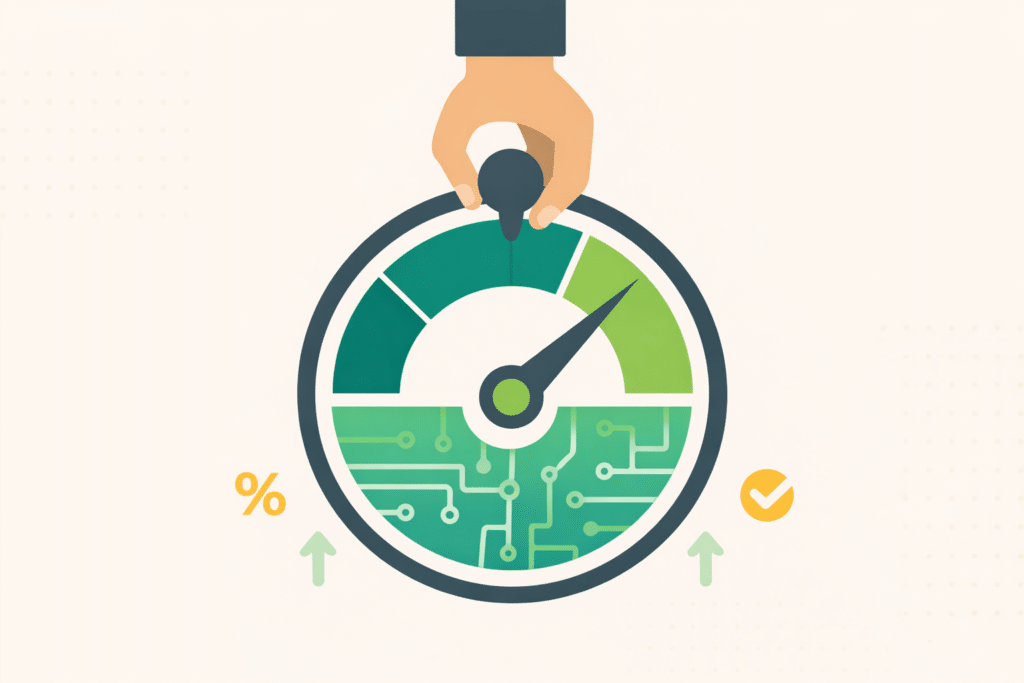
Amazon’s AI bidding and predictive targeting tools have improved significantly. In 2025-2026, most large sellers use some form of automation. The question isn’t whether to use AI—it’s how to use it without letting algorithms optimize for the wrong goals.
The Problem With Blind Automation
Amazon’s machine learning optimizes for what Amazon measures: clicks, impressions, attributed sales. It doesn’t know your margins, your inventory constraints, or your cash flow situation. Left unchecked, AI bidding will happily scale your spend toward a 50% ACOS if that generates more total sales.
Three Rules for AI-Assisted Bidding
- Set hard ACOS ceilings. Use portfolio bid strategies with maximum ACOS limits. Let AI optimize within those constraints, not beyond them.
- Validate recommendations weekly. When Amazon suggests bid increases, check whether the projected volume increase justifies the cost at your target margins. Often it doesn’t.
- Keep manual campaigns as controls. Maintain at least 20% of your budget in manually-optimized campaigns. This gives you baseline data to evaluate whether AI recommendations are actually improving performance.
Watch Out: “Optimize for conversions” sounds good until you realize Amazon’s definition of a valuable conversion might not match yours. A $12 sale and a $120 sale count the same in their attribution.
AI + Automation Readiness Checklist
Before expanding AI bidding:
- Break-even ACOS calculated for each product category
- Portfolio bid limits set at or below target ACOS
- Weekly review cadence established for AI recommendations
- Manual control campaigns running for baseline comparison
- Attribution windows understood (7-day vs. 14-day click impact)
How Often Should You Reallocate Budget Between Campaigns?
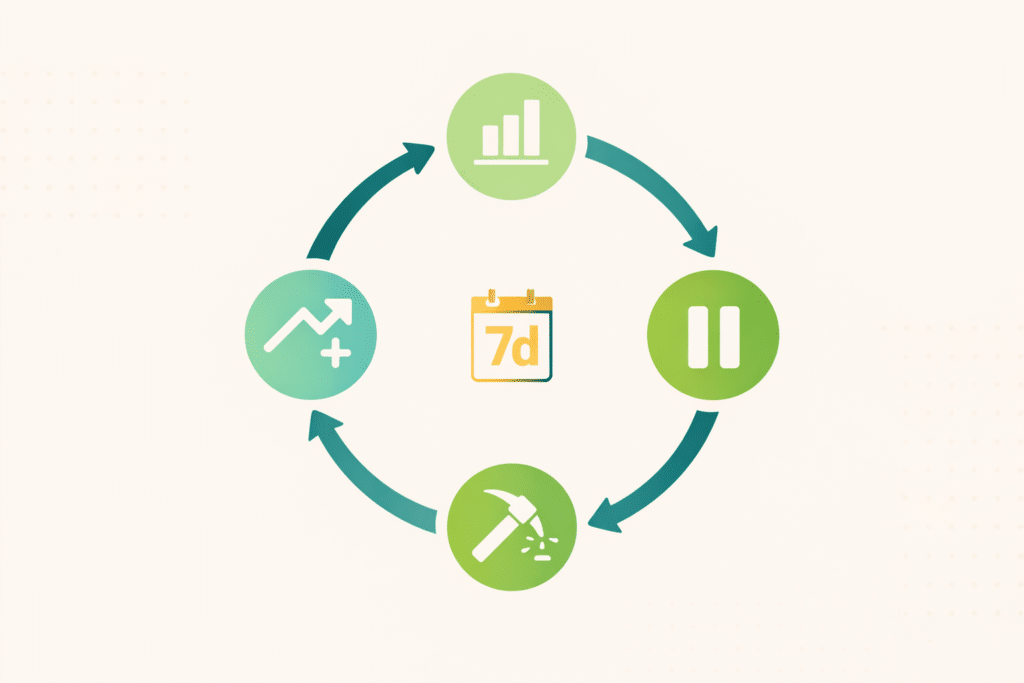
Weekly optimization is the minimum. Here’s a practical routine:
Monday Review Process
- Identify underperformers. Campaigns with ACOS more than 10 points above target need attention. Reduce bids, pause poor keywords, or cut budget.
- Find scaling opportunities. Campaigns significantly below target ACOS have room for more spend. Increase daily budget or bids to capture more volume.
- Move budget actively. Reallocate from underperformers to outperformers. Most sellers let poor campaigns run unchanged for months—don’t be one of them.
- Mine search terms. Review for new negative keyword opportunities and potential exact match targets.
The 80/20 Rule for Testing
Keep 80-85% of your budget on proven campaigns with predictable ROAS. Reserve 15-20% for testing new keywords, ad types, and audiences. This protects core performance while discovering new opportunities.
Pro Tip: Don’t over-optimize. Moving budget daily based on 24-48 hours of data leads to whiplash and prevents campaigns from accumulating enough data. Weekly is usually right. Bi-weekly works for smaller accounts.

How Does Amazon Advertising Fit With Other Channels?
The Cross-Platform Reality of 2026
Amazon ads don’t exist in isolation anymore. Your Amazon advertising strategy should account for—and coordinate with—what’s happening on Walmart Connect, TikTok Shop, and Meta Advantage+.
Patterns we see across platforms:
- Audiences overlap. Someone who sees your Meta ad might search for you on Amazon. Someone who discovers you on TikTok Shop might compare prices on Walmart. Attribution is messier than any single platform admits.
- CPCs correlate. When Amazon CPCs spike in a category, Walmart Connect often follows within 60-90 days as sellers diversify.
- Creative transfers. Video content that works on TikTok often performs well in Sponsored Brands Video and Amazon Inspire placements.
Dealing With Attribution Limitations
Signal loss isn’t just a Meta problem anymore. Amazon’s attribution has always been imperfect (last-click, 7 or 14-day windows), but the ecosystem is getting noisier.
Practical responses:
- Track blended metrics. TACOS across all channels, not just Amazon ACOS. If your total ad spend across platforms is 15% of total revenue and you’re profitable, the per-platform attribution matters less.
- Build first-party audiences. Amazon’s Brand Tailored Audiences, email lists from Shopify, customer data from repeat purchases. Owned audiences become more valuable as third-party targeting degrades.
- Test incrementality. Periodically pause campaigns to measure what happens to total sales, not just attributed sales. Some of your “high-performing” campaigns might be taking credit for organic sales.
Thinking About Hiring an Amazon Management Agency?
Canopy’s Partners Achieve an Average 84% Profit Increase!
Let’s talkWhat Does This Look Like at Different Budget Levels?
$5K Monthly Ad Spend
| Campaign Type | Budget | % |
| Sponsored Products | $4,000 | 80% |
| Sponsored Brands | $750 | 15% |
| Sponsored Display | $250 | 5% |
Target ACOS: 30-35% for growth, 20-25% if margin-constrained Test budget: $500 monthly for new keyword tests Focus: Nail Sponsored Products fundamentals before expanding
$25K Monthly Ad Spend
| Campaign Type | Budget | % |
| Sponsored Products | $16,250 | 65% |
| Sponsored Brands | $5,000 | 20% |
| Sponsored Display | $3,750 | 15% |
Target ACOS: 25-30% blended, with launch products allowed to run higher Test budget: $2,500 monthly for new campaigns and ad types Focus: Expand Sponsored Display retargeting, test SB Video
$75K+ Monthly Ad Spend
| Campaign Type | Budget | % |
| Sponsored Products | $45,000 | 60% |
| Sponsored Brands | $15,000 | 20% |
| Sponsored Display | $11,250 | 15% |
| DSP | $3,750 | 5% |
Target ACOS: 20-28% depending on category Test budget: $7,500 monthly including DSP experiments Focus: Cross-platform coordination, audience building, DSP retargeting
How Do You Start Restructuring Your Budget This Week?
Five-Step Action Plan
Step 1: Pull your campaign performance data for the last 30 days. Calculate ACOS and ROAS by campaign type.
Step 2: Compare your current allocation to the baselines above. If you’re overweighted in one area, identify why.
Step 3: Identify your bottom 20% of campaigns by ROAS. Pause or significantly reduce budget on campaigns that haven’t improved over 60+ days.
Step 4: Reallocate freed budget to your top 20% performers. Increase daily budgets on campaigns with headroom below target ACOS.
Step 5: Set a calendar reminder for weekly budget reviews.
Weekly Metrics Dashboard
| Metric | Why It Matters | Target Range |
| TACOS | Overall ad efficiency | 10–18% |
| ACOS by campaign type | Identify problem areas | Varies by goal |
| Average CPC trend | Cost inflation early warning | Stable or declining |
| Conversion rate | Are you reaching buyers? | Category-dependent |
Frequently Asked Questions
What percentage of my total Amazon revenue should go to advertising?
Most established brands target 10-18% TACOS. New brands or launches may run higher (20-30%) while building velocity. If your TACOS exceeds 25% long-term, you likely have a product margin problem or inefficient campaigns that need restructuring.
Should I split budget evenly across all my products?
No. Your top performers should get disproportionate budget. Concentrate 70-80% of your budget on the 20% of products driving most of your profitable revenue.
When should I increase my total advertising budget?
When you’re consistently hitting ACOS targets and campaigns are capped by daily budget limits. If you’re at target ACOS and could capture more impressions, you’re leaving profitable sales on the table.
Is Sponsored Display worth it for smaller sellers?
Yes, but start narrow. Retargeting campaigns typically deliver positive ROAS even at small budgets. Start with retargeting at 5-10% of total spend before expanding to competitor targeting.
Should I use Amazon’s AI bidding tools?
Yes, but with guardrails. Set hard ACOS ceilings, validate recommendations weekly, and keep manual campaigns as controls. AI optimizes for Amazon’s goals, not yours.
When Budget Optimization Requires More Bandwidth Than You Have
The framework above works. We’ve seen it work across hundreds of accounts. But there’s a difference between knowing what to do and having the time to do it well.
Canopy Management delivers end-to-end eCommerce growth, leading the industry in Amazon marketplace strategy while powering expansion through Shopify, Meta, and Google. Our full-funnel approach — from marketplace optimization to customer acquisition — has generated over $3.3 billion in partner revenue and made us the trusted growth engine for brands worldwide.
What makes the difference:
- Dedicated brand managers who know your account history, your margins, and your goals. Not a rotating cast of junior analysts following a playbook.
- Daily optimization during critical periods. When CPCs spike or a competitor launches an aggressive campaign, we’re adjusting in real-time.
- Cross-platform coordination. Your Amazon strategy should account for what’s happening on Walmart and TikTok Shop. We see patterns across platforms that single-channel managers miss.
- AI with human judgment. We use automation tools aggressively—but always validated against your actual unit economics, not Amazon’s preferred metrics.
If your 2026 goal is scaling profitably while competitors compete blindly on CPC, our team will show you precisely where your budget leaks and how to reinvest it toward efficiency.
Schedule a strategy session with our team to discover exactly how our proven frameworks can accelerate your growth.
Ready to Start Growing Your Amazon Brand?
Canopy’s Partners Achieve an Average 84% Profit Increase!
Find out more