The Best Amazon PPC Strategies . . . that Everybody Missed!
Canopy’s PPC team read the top-ranked Amazon PPC strategy guides and found the same blind spots in all of them. Here’s what they missed and how to fix it.


There is no shortage of Amazon PPC advice, and most of it repeats the same bidding tactics and placement settings. We read the ten top-ranked guides on Amazon advertising strategy and found the same blind spots in nearly all of them: optimizing for clicks instead of purchases, running automation without guardrails, and leaving audience segmentation unused.
This post covers those gaps and how to close them, across conversion-focused optimization, disciplined automation, segmentation, and dayparting. Amazon’s AI has changed how ads get matched and bid since most of those guides were written, which raises the cost of getting the basics wrong. The fundamentals still decide which accounts win, and they are exactly what the top-ranked guides keep missing.
1. Purchases, Not Clicks
Let’s say that you randomly picked ten articles talking about strategy. How many do you think would have headlines focused on “increasing clicks” or “improving click through rate (CTR)?”

We’d bet that a large percentage would focus on those popular metrics. If you concentrated on paid search, the numbers might be even higher.
A platform-wide focus on click-based metrics dominates the Amazon advertising space.
It’s not necessarily bad advice. Clicks indicate interest levels, allow tracking customer journeys, and factor into your quality score. Highly-relevant, attractively displayed ads are designed specifically to draw clicks. But ultimately, clicks themselves don’t define campaign success or failure.
At the end of the day, what truly matters are purchases and conversion rate. Did your Amazon ad spend drive sales? When you have options to bid on a target keyword, a significant part of your focus should be on purchases first.
Optimizing for clicks when you should be optimizing for purchases? Let's pressure-test your account.
Canopy's Partners Achieve an Average 84% Profit Increase!
Get Your Free PPC AuditUse Long-Tail Keywords to Drive Conversions
Uncovering relevant long-tail keywords should be a big part of your marketing strategy. Long-tail keywords can greatly boost e-commerce conversions by drawing in highly targeted traffic with strong purchase intent.
That’s because online shoppers using specific search phrases are typically deeper in the buying journey and more likely to make a purchase.
Keep a close eye on your return on ad spend (ROAS). On Amazon, your RoAS can be found under the Advertising tab. Here, you’ll find information about impressions, clicks, and your overall cost per sale.
If you’re using an Amazon Sponsored Products ad, rule-based bidding can help take the guesswork out of adjusting bids to achieve your target ROAS. For any existing campaign that has run at least 30 days with at least 30 conversions in the last 30 days, you can apply a rule with a ROAS guardrail and Amazon Ads will be able to adjust your base bids up and down to increase conversions while maintaining your guardrails.
Consider viewing optimizations through the lens of whether it will drive more revenue, rather than getting stuck chasing click volume.
Design ads to get attention without being misleading. Then, adjust your bids and matching strategies based on conversion behaviors. Many people often overlook this shift from search queries to purchases.
2. Amazon Automation (The Good Kind)
Winning the Amazon Buy Box – and the PPC advertising needed to do it – is becoming more challenging every day. When it comes time to scale an Amazon brand, individual sellers simply cannot manage bids, ads, keywords, and settings across thousands of product listings or locations.
Best practices like close variant matching, flexible bid strategies, and custom bids by segments are nearly impossible for a human alone when you hit a few hundred or thousand products.

If you’re not fortunate enough to have an Amazon agency doing this for you, this is where automatic targeting and advanced algorithms enter the game. Using artificial intelligence, machine learning, and automation can help overwhelmed advertisers keep up.
For an Amazon agency, automation of standard practices is particularly impactful because it frees up the humans to attend to the volatile situations that require years of specific ecommerce experience to untangle.
We’d argue that automation alone isn’t enough to help you connect with your target audience. That’s where advanced advertising management comes in.
Sure, an AI program might help you to manage a few dozen product bids and produce just-ok ad performance. The best Amazon agencies strategically combine closely monitored automation with the latest advances in artificial intelligence. That’s when we really see exponential growth.
If you’re weighing outside help, our Amazon PPC agency comparison covers ten agencies worth evaluating.
3. Amazon Ad Segmentation
The vast majority of paid search targeting still comes down to picking products, keywords, and match types. But there is a much wider world of options to precision-target the right potential customers. Variables like demographics, user intent, behaviors, and devices used allow customization at a person-by-person level.
For example, “Similar to advertised products” product targeting for Sponsored Display is a dynamic Amazon ad segmentation option that allows advertisers to leverage machine learning to help reach hyper-relevant audiences.
Advertisers can use dynamic segments through the Amazon Ads API by creating a contextual targeting clause of type “similarProduct”.
Using dynamic segments, advertisers can target additional products that are similar to those being advertised and help sellers reach relevant audiences most likely to click and help drive traffic to advertised products.
Imagine you find mobile phone buyers from higher incomes households have exceptionally high conversion rates. You can create a specific ad group and set aggressive mobile bids just for this audience.
Here are three ways to boost segmentation for even better campaign results:
Use multiple data signals
Combining variables like income and mobile users is more powerful than a single trait. It creates exponential benefits. You can build segments using site analytics, CRM data, and third party sources.
Test new variants frequently
Customer data and behaviors evolve rapidly. Routinely build and experiment with new segments to catch trends. Take advantage of the rapid advances in artificial intelligence to move quickly.
Assign dedicated budgets
Rather than evenly spreading funds, dynamically shift budgets to your best performing segments to maximize ROI. Again, AI can help you filter through multiple accounts and ad campaigns to make changes quickly enough to affect your ROAS and ultimately, your bottom line.
4. Focus a Microscope On Your Ad Campaign With Dayparting
There are many aspects of everyday life that have been dramatically affected by the recent advancements to artificial intelligence. Ecommerce is at the forefront of that trend, with AI making quick work of the data-heavy complexities of Amazon ad campaigns.
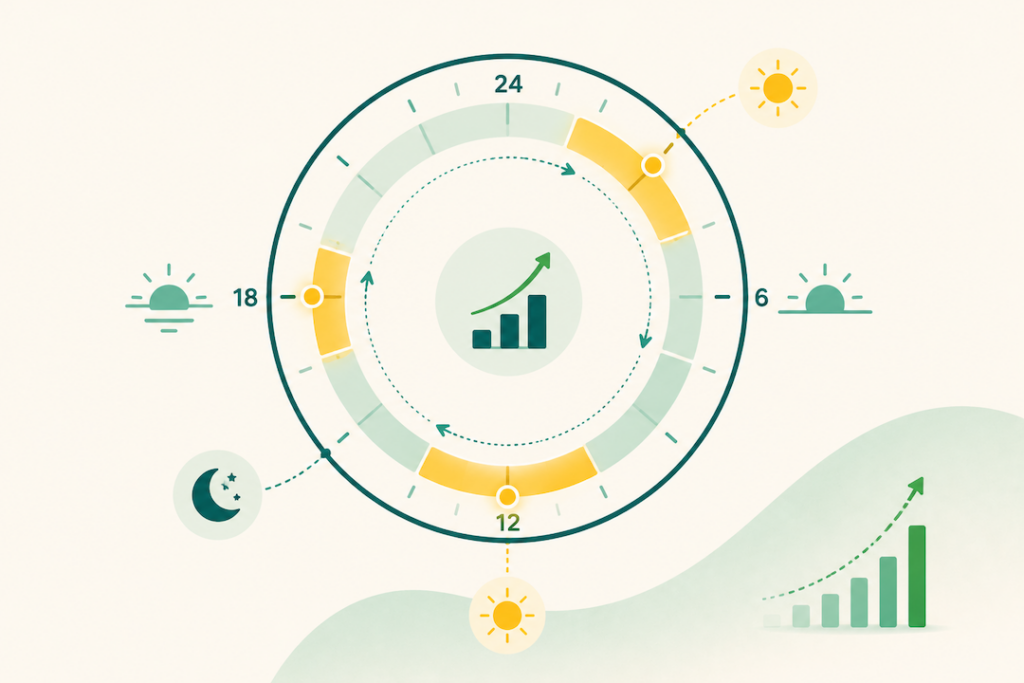
Dayparting is an advanced PPC optimization technique where ads are scheduled to run only during specific times of the day or week. This strategy takes into account that consumer behavior and purchasing patterns can vary dramatically throughout a relatively short period of time.
To implement a dayparting strategy:
- Analyze Sales Data: Identify peak shopping hours for your products.
- Review PPC Performance: Determine when your ads are most effective.
- Set Up Custom Ad Schedules: Focus your budget on high-performing times in your Amazon PPC campaigns.
For example, if you sell office supplies, your ads might perform best during weekday business hours. If you sell entertainment products, evenings and weekends might be your prime time.
Benefits of Dayparting:
- More efficient use of your ad budget.
- Improved click-through rates (CTR) and conversion rates.
- Reduced ad spend during less profitable hours.
5. Seasonal Keyword Strategies
Amazon sellers spend a lot of time preparing for seasonal events like Prime Day. That’s why it’s a little bit strange that most of the top posts don’t mention the required seasonal ad campaign adjustments necessary to be successful.
Adjusting PPC strategies for seasonal trends and holiday shopping periods is crucial for maximizing sales during peak times. This involves creating separate campaigns and adjusting bids and budgets for seasonal keywords during high-traffic periods like Black Friday, Cyber Monday, or Christmas.
To implement a seasonal keyword strategy:
- Identify Relevant Seasonal Events: Determine which holidays or events are relevant for your products.
- Research Seasonal Keywords: Compile a list of keywords related to these events.
- Create Separate Campaigns: Set up individual campaigns for each major seasonal event.
- Adjust Bids and Budgets: Account for increased competition during these periods.
- Optimize Listings: Use seasonal keywords and imagery in your product listings.
- Plan Ahead: Schedule these campaigns well in advance of the seasonal event.
Key Considerations for Seasonal Campaigns:
- Start early to capture early shoppers and build campaign history.
- Gradually increase bids as the seasonal event approaches.
- Prepare for higher CPCs during peak shopping periods.
- Monitor inventory closely to avoid stockouts during high-demand periods.
- Adjust your main campaigns to account for seasonal shifts in search behavior.
Frequently Asked Questions
Most sellers see early gains 2 to 4 weeks after shifting from click-focused to conversion-focused optimization, with substantial results by day 45 to 60. The algorithm needs purchase data to learn, so campaigns under 10 sales a week take longer. Give the strategy a full quarter before a major pivot, but you should see conversion rates rising and long-tail ACoS falling within the first month.
Use both, with different jobs. Automatic campaigns are for discovery, surfacing search terms and ASINs you would not have targeted on your own, while manual campaigns are for control, letting you scale proven winners with precise bids. Start new products on automatic, and after 2 to 4 weeks and 20-plus orders, move the high performers into tightly managed manual campaigns while keeping automatic running at a lower budget for ongoing discovery.
Amazon’s rule-based bidding needs real history first: a campaign running at least 30 days with at least 30 conversions in the last 30 days before you can apply a rule. In practice that means roughly $500 to $1,000 a month in spend, or 15 to 20 PPC orders a week, since below that the system lacks the data to bid well. If automation pushes your ACoS higher than you want, your ROAS guardrail is set too loose, so tighten it gradually and turn automation on for your most stable campaigns first.
Split out a segment only when the data shows it converts at least 30% above your account average and you have the volume to trust that read. The ones that usually clear the bar are mobile buyers in impulse categories, repeat purchasers of your brand, and in-market shoppers actively browsing your category. Start with one or two obvious segments, prove the model, then expand, rather than creating segments just because you can.
Yes, if your product has clear time-based demand. Coffee makers sell in the morning, B2B products during business hours, and even a $20 daily budget gains from concentrating spend in peak windows. It needs about 30 days of hourly data before the patterns are reliable, so under roughly $1,000 a month, get keyword selection and negative keywords solid first. Past that, dayparting can lift efficiency 15 to 25% even at small scale.
Yes. Amazon puts conversion-focused optimization, automation, and segmentation right in the advertising console, and a solo seller with 5 to 10 products can master them with focused effort. What an agency like Canopy adds is proprietary technology watching thousands of data points, pattern recognition across hundreds of brands, and specialists who react to market shifts in real time. Brands running 50-plus SKUs across categories usually find the complexity outgrows what one person can manage alongside the rest of the business.
How Canopy Management Can Help
Canopy Management is a full-service omnichannel agency based in Austin, Texas. We run Amazon, Walmart, TikTok Shop, Shopify, Meta, and Google for brands doing $20K to $1.5M in monthly revenue, with the same dedicated brand manager owning the account for the life of the engagement.
The numbers we lead with: $3.3 billion in partner revenue, 84% average year-over-year profit increase, and 99.1% partner retention.
Schedule a strategy session to see how we’d approach your account.
Optimizing for clicks when you should be optimizing for purchases? Let's pressure-test your account.
Canopy's Partners Achieve an Average 84% Profit Increase!
Get Your Free PPC Audit