Amazon Advertising for New Products: Your First 90 Days
The launch window is when Amazon pays the most attention to your listing. Here’s how to build campaigns that generate the right signals fast.


A brand came to us after their Amazon launch had already failed. When we dug into the account, the story was familiar: $40,000 spent in six weeks, ACoS at 140% by week three, plug pulled entirely by week six. Good product, strong reviews from their DTC site. None of it mattered because they’d treated advertising as something you turn on rather than something you build.
The product eventually did well. But it took another four months and a complete restructure.
The first 90 days of a launch are when Amazon is paying the most attention to your listing. The algorithm is actively figuring out what you are and who should see you. Your job is to give it clear answers, fast.
What Signals Does Amazon’s Algorithm Look for During a Product Launch?

Amazon’s algorithm heavily weights signals like CTR, conversion rate, and sales velocity across relevant search terms to decide whether a new product deserves more visibility.
Click-through rate (CTR) measures how often shoppers click your listing when they see it in search results. Strong CTR tells Amazon your main image, title, and price are relevant to the query. Weak CTR kills launches before they start because Amazon stops showing listings that shoppers ignore.
Conversion rate (CVR) measures how often shoppers buy after landing on your page. A 15% conversion rate tells Amazon to show you more. An 8% conversion rate tells it to show you less. During a launch, Amazon is testing whether your product converts well enough to deserve ongoing visibility.
Purchase velocity across search terms measures whether you convert on a range of related keywords, not just one. A product that sells on “stainless steel water bottle” and “insulated bottle for gym” and “metal water bottle BPA free” signals broader relevance than one that only converts on a single term. Amazon rewards products that satisfy multiple search intents.
Your advertising exists to generate these signals deliberately. Without structure, you’re hoping the algorithm figures you out. Sometimes it does. Usually it doesn’t.
What Campaign Structure Works Best for Amazon Product Launches?

The most effective launch structure uses three layers: discovery campaigns that find what works, intent capture campaigns that scale winners, and brand presence campaigns that build visibility beyond search.
How Do Discovery Campaigns Work?
Discovery campaigns identify which keywords and ASINs convert for your product before you know enough to target precisely.
Sponsored Products Auto campaigns test four targeting types simultaneously: close match, loose match, complements, and substitutes. Within two weeks, you’ll have data on dozens of search terms you never would have targeted manually. Auto campaigns have a bad reputation because people treat them as set-and-forget. Used as a research tool with weekly harvesting, they’re powerful.
Sponsored Products Broad Match campaigns should start with 5-12 keywords, not 30 or 50. A tight list of terms that directly describe your product generates cleaner data than a sprawling list where you can’t tell what’s working.
Product Targeting campaigns should aim at 10-20 competitor ASINs at similar price points with similar review counts. This tests whether shoppers comparing alternatives will choose you.
Ready to Start Growing Your Amazon Brand?
Canopy’s Partners Achieve an Average 84% Profit Increase!
Find out moreWhat Are Intent Capture Campaigns?
Intent capture campaigns are Exact Match campaigns built from search terms that have already proven they convert. After two or three weeks, your discovery campaigns will show patterns. Some search terms convert. Most don’t. The winners move into Exact Match where you control bids precisely.
This is where most sellers make mistakes. They leave converting terms in Auto and Broad, competing against themselves. Or they move terms to Exact but don’t add them as negatives in discovery campaigns.
The rule: when a search term proves it converts, move it to Exact Match and add it as a negative everywhere else. High-intent traffic flows to the campaign where you have the most control.
When Should You Launch Sponsored Brands and Sponsored Display?
Sponsored Brands and Sponsored Display serve a different purpose than Sponsored Products. They build brand presence rather than capturing immediate conversions.
An Amazon Sponsored Brands campaign pointing to your Storefront puts your logo in front of shoppers searching relevant terms. Amazon Sponsored Display campaigns targeting competitor product detail pages mean shoppers see your product while considering alternatives.
If budget is constrained, focus on Sponsored Products for the first 30 days. If you have room, running Brands and Display from day one builds presence that compounds over time.
What Should You Do in the First 30 Days of a Launch?
The first 30 days are for learning, not profitability. Expect high ACoS and budget for it. You’re paying for information that will drive decisions for months.
Set bids above Amazon’s suggested bid. Underbidding in month one is the most common launch mistake. Amazon gives new products a brief window of extra visibility. Low bids mean you don’t win enough auctions to collect meaningful data. You end up with impressions trickling in over weeks instead of a concentrated burst that tells you something useful.
Pull your Search Term Report weekly. Find terms that converted and move them to Exact Match campaigns. Find terms that spent without converting and add them as negatives. This weekly review is tedious and essential. People who check monthly waste weeks of budget on terms that were never going to convert.
Don’t panic at high ACoS. A 100% ACoS in week two isn’t failure. It’s the cost of learning which keywords work before you have data. The brands that succeed through launches are the ones who maintain spend through the learning period rather than cutting bids at the first sign of loss.
What Should You Do in Days 31-60?
Days 31-60 are for building on what you’ve learned. By now you should have 15-40 search terms with actual conversions. These are your foundation.
Shift budget from discovery to Exact Match. Your Exact Match campaigns should be growing while Auto and Broad budgets shrink. If 60% of your spend is still in discovery campaigns at day 45, you haven’t built anything.
Test placement modifiers on your best keywords. Amazon lets you bid up for top-of-search placement. For some keywords it’s worth it. But not all. A keyword converting at 12% mid-page might convert at 14% at top-of-search, but if top-of-search costs twice as much per click, you’re losing money. Test and let data decide.
Expand product targeting based on what’s working. You’ve learned which competitor ASINs convert. Add more that look similar. Add accessories and complementary products that attract the same shopper.
What Should You Do in Days 61-90?
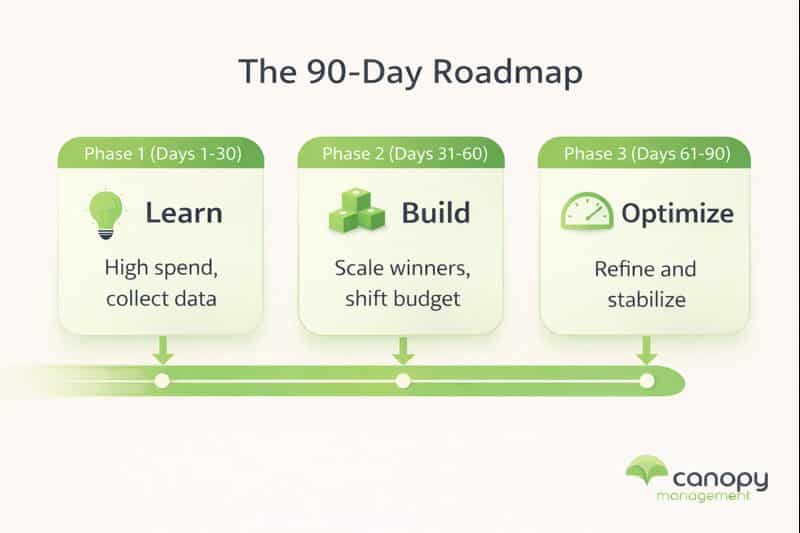
Days 61-90 are for optimization and stabilization. If you’ve done the work in months one and two, month three is refinement. Your keyword list is driven by performance data, not guesses.
Lower discovery bids further and shift that budget to proven winners. By now, Exact Match campaigns should represent the majority of your spend.
Launch Sponsored Brands Video if you haven’t. Video ads frequently outperform static formats in tests and case studies, in both CTR and conversion rate.
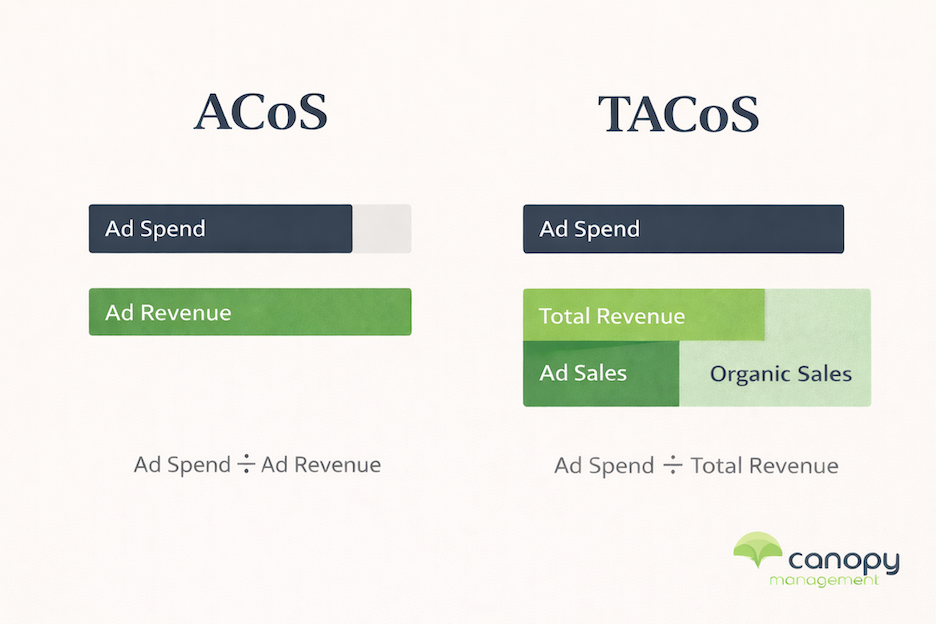
Monitor TACoS for stabilization. TACoS (Total Advertising Cost of Sale) measures ad spend as a percentage of total revenue, including organic sales. By day 90, TACoS should be trending down as organic sales grow. If it’s not stabilizing, something is wrong with your listing or your targeting.
What Is TACoS and Why Does It Matter for Launches?
TACoS (Total Advertising Cost of Sale) measures your ad spend as a percentage of total revenue, not just attributed ad revenue. It’s calculated by dividing total ad spend by total sales (both organic and paid).
TACoS matters more than ACoS for launches because it shows whether advertising is building organic momentum. A product with 80% ACoS but 25% TACoS is healthy: ads are expensive but driving enough organic sales to justify the spend. A product with 40% ACoS but 40% TACoS is in trouble: nearly all sales depend on advertising.
During a launch, expect TACoS to start high (sometimes 50%+) and decline over 90 days as organic ranking improves. If TACoS isn’t declining by day 60, investigate whether your listing converts well enough to rank organically.
What Are the Most Common Amazon Launch Advertising Mistakes?
Advertising a listing that isn’t ready. Your main image is the ad. If it doesn’t stop the scroll, no amount of targeting will save you. Advertising can’t fix a listing problem. It can only expose one faster. Before spending on ads, confirm your images work on mobile, your price is competitive, and your reviews (if any) aren’t killing conversion.
Underbidding at launch. Amazon pays attention to new products early. Conservative bids waste the window when building momentum is easiest. Sellers see early losses and cut bids, which reduces impressions and extends the learning period. Bid high early, collect data fast, then optimize.
Treating Auto campaigns as a strategy. Auto campaigns should feed your Exact Match campaigns, not replace them. Auto is a research tool. If you’re still running most of your spend through Auto at day 60, you haven’t built a real advertising structure.
Ignoring the Search Term Report. The Search Term Report shows exactly which queries triggered your ads and whether they converted. Reviewing it weekly during launch is non-negotiable. Monthly reviews mean you’ve wasted weeks of budget before catching problems.
Why Would a Structured Launch Still Fail?
A structured launch gives you the best odds, but not a guarantee. Some products launch into categories so competitive that even well-run campaigns can’t overcome entrenched incumbents. Some have fundamental issues with demand, pricing, or differentiation. And some launches don’t click for reasons that aren’t obvious even after reviewing all the data.
The 90-day timeline isn’t arbitrary. That’s roughly how long it takes to build enough keyword relevance and sales history to rank organically. If your product isn’t gaining traction by day 90, reassess the fundamentals: product-market fit, listing quality, price positioning, competitive landscape. More ad spend rarely solves a problem showing up that late.
What a structured launch does guarantee is data. You’ll know which keywords convert, which don’t, and whether the unit economics can work. That’s worth having even when the answer is “this product needs changes before it can succeed.”
Thinking About Hiring an Amazon Management Agency?
Canopy’s Partners Achieve an Average 84% Profit Increase!
Let’s talkCommon Questions About Amazon Launch Advertising
How much should I budget for an Amazon product launch?
Budget 20-40% more than your intended steady-state spend for the first 90 days. The first 30-45 days will run at a loss. You need concentrated spend early to generate data quickly. A brand planning to spend $3,000/month at maturity should budget $4,000-4,500/month during launch.
When should I start Exact Match campaigns for a new product?
Start Exact Match campaigns after you have 5-10 search terms with actual conversions, typically in week two or three. Moving terms to Exact Match before you have conversion data means you’re guessing instead of building on evidence.
What does it mean if I have good CTR but bad conversion rate?
Good CTR with poor conversion almost always indicates a listing problem, not a targeting problem. Shoppers are interested enough to click but something on the page stops them from buying. Check your price against competitors, read one-star reviews on similar products for common objections, and view your images on mobile. The problem is on the page, not in the ads.
How often should I review my Search Term Report during a launch?
Review the Search Term Report weekly for the first 45 days, then every two weeks after. Weekly reviews during the learning phase let you move converting terms to Exact Match and negative out wasted spend before it compounds. Monthly reviews are too slow for the pace of a launch.
Should I run a coupon during my Amazon product launch?
Usually yes. A 5-10% coupon improves both CTR (the green badge catches attention in search results) and conversion rate (shoppers like feeling they got a deal). Factor the coupon cost into your expected launch-period loss rather than treating it as separate from advertising.
What’s the difference between ACoS and TACoS?
ACoS (Advertising Cost of Sale) measures ad spend divided by ad-attributed revenue. TACoS (Total Advertising Cost of Sale) measures ad spend divided by total revenue including organic sales. TACoS is the better health metric for launches because it shows whether advertising is building organic momentum or just buying all your sales directly.
How long does it take for a new Amazon product to rank organically?
Most products need 60-90 days of consistent sales velocity and keyword relevance signals before organic ranking stabilizes. Advertising accelerates this by generating sales across target keywords, but it’s not instant. Products that cut advertising too early often lose the organic momentum they were building.
What should I do if TACoS isn’t improving after 60 days?
Flat or rising TACoS after 60 days usually means one of three things: your listing doesn’t convert well enough to rank organically, you’re advertising on keywords where you’re not truly relevant, or competition is too strong for your current offer. Audit your conversion rate against category benchmarks, review which keywords are actually driving sales, and assess whether your price and reviews can compete.
Working With Canopy
Ready to partner with a team that has the systems and expertise to scale your brand?
Canopy Management delivers end-to-end eCommerce growth, leading the industry in Amazon marketplace strategy while powering expansion through Shopify, Meta, and Google. Our full-funnel approach — from marketplace optimization to customer acquisition — has generated over $3.3 billion in partner revenue and made us the trusted growth engine for brands worldwide.
Schedule a strategy session with our team to discover exactly how our proven frameworks can accelerate your growth.
Ready to Start Growing Your Amazon Brand?
Canopy’s Partners Achieve an Average 84% Profit Increase!
Find out more