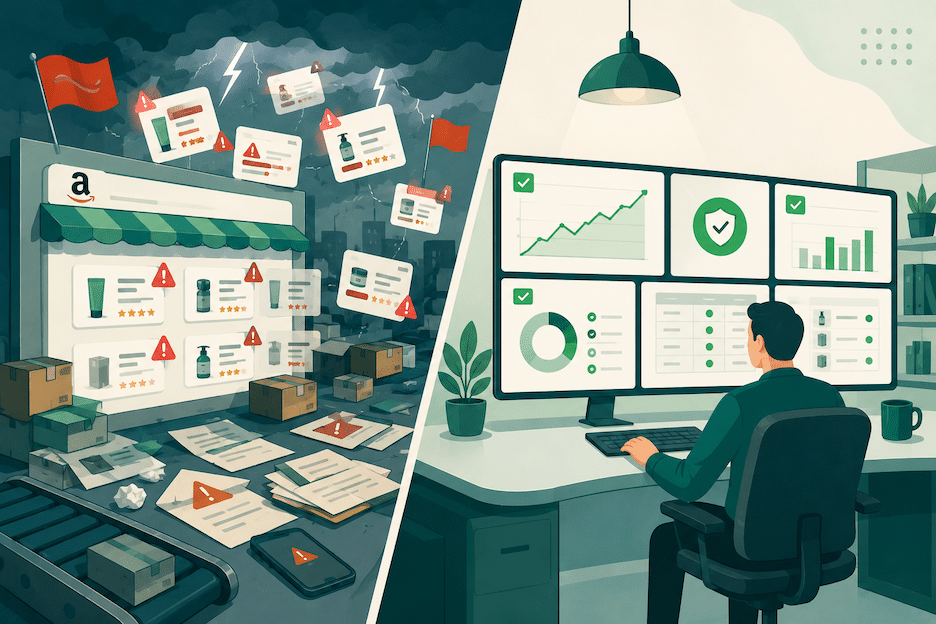
Amazon PPC Management Agency: Why You Need One in 2026
Want to get (and stay) ahead of your competition on Amazon? Here’s what an Amazon PPC Agency provides and why NOW is a great time to hire one!


Amazon’s marketplace dominance continues to accelerate, with the company’s total net sales revenue exceeding $638 billion worldwide in 2024. With access to Amazon’s audience of over 300 million active customers globally, effective advertising has never been more crucial, or more complex.
The challenge?
As Amazon’s ecosystem expands, so does the competition. More than 9.7 million active sellers now compete for visibility, and Amazon’s advertising platform has evolved into a sophisticated system that rewards expertise and punishes inefficiency.
The stakes are simple: Without professional Amazon PPC management in 2026, you’re likely leaving significant revenue on the table while overspending on underperforming ads.
Thinking About Hiring an Amazon Management Agency?
Canopy’s Partners Achieve an Average 84% Profit Increase!
Let’s talkUnderstanding the Current Amazon Advertising Ecosystem
Amazon’s advertising platform has expanded dramatically in recent years, offering both greater opportunities and complexity:
1. Sponsored Products Ads
These search and product page placements now include sophisticated targeting options:
- Purchase behavior targeting – Reach customers based on their buying history
- Brand affinity targeting – Connect with shoppers interested in similar brands
- Dayparting – Schedule ads during peak conversion periods
2. Sponsored Brands Ads
These premium placements now feature:
- Video integration within the ad unit
- Custom landing experiences directing to curated brand pages
- Comparative messaging capabilities (within Amazon’s guidelines)
3. Sponsored Display Ads
These versatile ads extend your reach:
- On-site remarketing to shoppers who viewed your products
- Off-site extension to third-party websites
- Lifestyle targeting based on interests and behaviors
- Competitor targeting on competing product pages
4. Amazon DSP (Demand-Side Platform)
This programmatic solution provides:
- Advanced audience targeting using Amazon’s first-party data
- Cross-device reach across Amazon properties and partner sites
- Connected TV advertising on Prime Video and related services
- Full-funnel analytics for comprehensive optimization
5. Amazon Attribution
This measurement tool delivers:
- Cross-channel attribution for external marketing efforts
- Customer journey mapping across touchpoints
- Conversion insights for non-Amazon marketing channels

Why DIY Amazon Advertising Falls Short in 2025
Most brands approach Amazon advertising with an outdated perspective:
❌ DIY Assumption: “Managing our own campaigns saves money”
✅ The Reality: When we audit self-managed campaigns, we consistently find that 30% to 45% of ad spend is wasted on non-converting traffic, underperforming keywords, and structural inefficiencies.
Today’s Amazon advertising landscape requires expertise in:
- AI-driven bidding algorithms that change hourly
- Complex attribution models determining ad effectiveness
- Cross-marketplace strategy coordination
- First-party data integration for targeting
- Voice search optimization for Alexa-driven queries
For most brands, the question isn’t whether you can afford professional PPC management. It’s whether you can afford to operate without it.
5 Critical Components of Successful Amazon Advertising in 2025
1. Advanced Keyword Intelligence
Modern Amazon advertising requires sophisticated keyword strategy beyond basic research. Effective keyword management includes:
- Analyzing search term performance across billions of data points
- Identifying high-converting semantic patterns invisible to manual analysis
- Predicting emerging search trends before they appear in standard tools
- Optimizing match types based on performance patterns
Professional keyword intelligence transforms how efficiently your ad spend converts to sales, often revealing opportunities that manual research simply can’t uncover.
2. Strategic Negative Keyword Architecture
Eliminating wasted ad spend is as crucial as targeting profitable keywords. A proper negative keyword strategy includes:
- Negative exact matching to eliminate specific non-converting queries
- Negative phrase protection to prevent broad match expansion into irrelevant territory
- Campaign isolation to avoid bidding against yourself across campaigns
- Auto-campaign refinement to continuously improve targeting precision
The difference between campaigns with sophisticated negative keyword architecture and those without is dramatic. Properly structured negative keywords can reduce wasted spend by tens of thousands of dollars monthly for brands with substantial ad budgets.
3. Dynamic Bid Management
Static bidding strategies fail in today’s rapidly changing marketplace. Effective bid management includes:
- Real-time bid adjustments based on conversion probability
- Competitive position monitoring to maintain optimal placements
- Dayparting optimization to focus spend during high-conversion hours
- Device-specific bidding to prioritize platforms with better performance
- Geographic bid modulation to target high-performing regions
Dynamic bidding approaches consistently outperform static strategies by responding to real-time marketplace conditions and competitor activity.

4. Competitive Intelligence
Understanding your competition provides the strategic edge needed in crowded categories:
- Market penetration mapping to identify competitive white space
- Share of voice analysis across relevant keywords
- Pricing strategy intelligence for optimal positioning
- Content gap identification for listing optimization
- Promotion timing insights to anticipate competitive moves
Brands that actively monitor and respond to competitive dynamics consistently capture greater market share within their categories.
5. Performance Analytics Beyond Basic Metrics
Success requires measuring what matters. Sophisticated analytics include:
- Attribution modeling across all touchpoints
- Incrementality testing to measure true advertising impact
- Profitability analysis at the ASIN and ad group level
- New-to-brand customer acquisition tracking
- Lifetime value projection for advertising-acquired customers
Advanced analytics reveal optimization opportunities that basic reporting misses entirely, enabling strategic decisions that compound performance improvements over time.
Which Brands Benefit Most from Professional PPC Management?
1. Established Brands Seeking Growth
For brands with 7+ figure annual revenue, professional PPC management provides the expertise needed to scale while maintaining profitability.
2. New-to-Amazon Brands
Launching on Amazon requires navigating a complex ecosystem. Professional management helps avoid costly mistakes and establishes strong performance from day one.
3. Brands in Competitive Categories
In highly competitive niches, expert campaign optimization makes the difference between visibility and obscurity.
4. Seasonal Businesses
Businesses with significant seasonal fluctuations benefit from advanced planning and strategic budget allocation throughout the year.
5. Brands with Complex Product Portfolios
Managing advertising across diverse product categories requires sophisticated campaign architecture and cross-portfolio optimization.

Key Questions to Ask When Evaluating Amazon PPC Management Services
1. What is their approach to campaign structure?
Look for: Multi-tiered campaign architecture with clear isolation between targeting methods
2. How do they handle negative keywords?
Look for: Sophisticated negative keyword architecture, not just basic exclusions
3. What technology do they use for campaign management?
Look for: Proprietary tools that go beyond Amazon’s native advertising console
4. What reporting and analytics do they provide?
Look for: Custom dashboards with actionable insights, not just raw data
5. What is their approach to testing and optimization?
Look for: Structured testing protocols with clear performance benchmarks

The Future of Amazon Advertising: 2025 and Beyond
Several emerging trends are reshaping Amazon advertising strategies:
1. AI-Driven Creative Optimization
Machine learning algorithms now optimize ad creative elements in real-time, automatically adjusting images, copy, and calls-to-action to maximize conversion rates.
2. Retail Media Network Expansion
Amazon’s advertising reach extends beyond its own platform, allowing brands to reach customers throughout their entire online journey through Amazon’s expanding media network.
3. Unified Commerce Measurement
Advanced attribution models provide a complete view of how Amazon advertising impacts both online and offline sales, creating opportunities for holistic marketing strategies.
4. Voice Commerce Integration
With over 40% of Amazon searches now initiated through voice devices, advertising strategies specifically optimized for voice search represent a major opportunity.
5. Sustainability Credentials
Amazon’s focus on sustainability extends to advertising, with preferential placement for products that meet climate pledge criteria and demonstrate environmental responsibility.
Ready to Start Growing Your Amazon Brand?
Canopy’s Partners Achieve an Average 84% Profit Increase!
Find out moreFrequently Asked Questions About Amazon PPC Management
How much does Amazon PPC management typically cost?
Based on industry standards, most reputable agencies charge either a percentage of ad spend (typically 8% to 15%) or a flat monthly fee based on account complexity. Percentage-based pricing aligns the agency’s success with yours, they only earn more when your ad spend increases profitably. Flat-fee arrangements work well for brands with larger, more stable budgets.
The key is understanding what’s included in that fee: reporting, creative development, listing optimization support, and strategic guidance should all be part of the package. When evaluating cost, focus on the return you’re getting rather than the fee itself. An agency charging 12% that delivers 40% profit improvement is far more valuable than one charging 8% with marginal results.
How long does it take to see results from professional PPC management?
While initial improvements can be seen within the first two weeks, significant performance gains typically emerge within 60 to 90 days as optimization strategies take full effect. The first two to three weeks involve auditing your current setup, implementing proper campaign structure, and starting testing protocols. Weeks four to eight focus on refining targeting based on performance data and eliminating wasted spend through negative keyword architecture.
By month three, you should see measurable improvements in key metrics like ACoS, ROAS, and conversion rates. Brands starting with poorly structured campaigns often see faster initial gains, while already-optimized accounts require more sophisticated strategies to achieve incremental improvements.
Will I lose control of my advertising if I hire an agency?
No. The best Amazon agencies operate as an extension of your team. You maintain final approval on budgets and strategies while benefiting from their expertise and execution. Full service Amazon agency relationships involve regular communication, typically through weekly or biweekly calls where you review performance, discuss strategy adjustments, and align on priorities.
You’ll have access to real-time dashboards showing exactly how your budget is being spent and what results you’re getting. Think of it like hiring a specialist, you’re delegating the technical execution to experts while maintaining strategic oversight. If an agency tries to operate in a black box without transparency or regular communication, that’s a red flag.
What’s the minimum ad spend required to work with an agency?
While most agencies have minimum requirements (typically $3,000 to $5,000 monthly ad spend), the focus should be on ROI rather than management costs. These minimums exist because effective campaign management requires sophisticated testing, proper campaign structure, and ongoing optimization that isn’t economically viable at very low spend levels.
If you’re spending less than $3,000 monthly, you might not have enough data volume for meaningful optimization, making professional management less effective. However, if you’re planning to scale and just starting out, some agencies will work with lower initial budgets with the expectation of growth. The question isn’t just whether you meet the minimum, it’s whether the economics make sense for your business.
How do agencies stay current with Amazon’s constant changes?
Professional agencies maintain direct relationships with Amazon, participate in beta programs, and invest in ongoing education to ensure strategies remain current with platform developments. Many established agencies have dedicated Amazon account representatives who provide early access to new features and direct support when issues arise.
They also invest in continuous team training, industry conferences, and Amazon’s official certification programs. Perhaps most importantly, agencies managing multiple accounts see patterns and changes across their entire client base, giving them insights that individual sellers simply can’t access. When Amazon rolls out a new feature or algorithm change, an agency managing 50+ accounts can quickly identify what works and apply those learnings across their portfolio.
What’s the difference between hiring an agency and using Amazon’s Managed Services?
Amazon’s Managed Services provides hands-on campaign management directly from Amazon, but it typically requires minimum spend commitments that often start around $50,000 monthly and focuses primarily on spending your budget rather than maximizing profitability. Independent agencies offer more flexibility with lower minimums, focus on your profit margins rather than just spending budget, and provide strategic guidance that considers your entire business, not just Amazon’s revenue goals.
Amazon’s team manages thousands of advertisers, while a dedicated agency account manager might handle 10 to 15 clients, giving you significantly more personalized attention. That said, Amazon Managed Services can be valuable for very large brands who need direct platform access and are comfortable with the spending requirements.
Should I hire a specialist Amazon PPC agency or a general digital marketing agency?
In our experience managing campaigns across both specialist and generalist approaches, specialist Amazon agencies consistently deliver superior results for marketplace advertising. Amazon’s advertising platform operates fundamentally differently from Google Ads or Facebook Ads, with unique bidding mechanics, placement types, and attribution models. General agencies often try to apply Google Ads strategies to Amazon, which leads to wasted spend and missed opportunities.
Specialist agencies understand Amazon-specific concepts like share of voice, the relationship between organic ranking and ad performance, and how to structure campaigns to avoid competing with yourself. They also have established relationships with Amazon and access to beta features that generalists don’t. Unless you need cross-channel management and Amazon is just a small part of your marketing mix, a specialist agency will deliver better performance.
How do I know if my current agency is doing a good job?
Look for consistent improvement in profitability metrics, transparent reporting with actionable insights, and proactive communication about opportunities and challenges. Your ACoS should be declining or stable while sales volume grows, indicating efficient scaling. You should receive regular reports that explain not just what happened, but why it happened and what the agency is doing about it.
Warning signs include vague explanations for poor performance, reluctance to share detailed data, lack of proactive optimization recommendations, and static campaign structures that don’t evolve over time. A good agency should be testing new strategies, identifying growth opportunities, and showing clear correlation between their actions and your results. If you’re not seeing measurable improvement after 90 days, or if communication feels like pulling teeth, it’s time to reevaluate.
Can an agency help if my account is already profitable but growth has stalled?
Yes, this is actually one of the most common scenarios where agencies add significant value. When brands hit a growth plateau, it usually means they’ve maximized their current strategy and need more sophisticated approaches. Professional agencies can identify untapped keyword opportunities, expand into new campaign types like DSP or Sponsored Display, optimize campaign structure to reach new audiences, and implement testing protocols to break through performance ceilings.
Stalled growth often indicates you’re competing with yourself across campaigns, missing high-value long-tail keywords, or have reached saturation in your current targeting. An experienced agency can diagnose these issues and implement solutions that reignite growth while maintaining or improving profitability.
What happens to my campaigns if I decide to stop working with an agency?
You retain full ownership of your campaigns and all the optimizations the agency implemented. When you part ways with an agency, your campaign structure, keyword research, negative keyword lists, and bidding strategies remain in your account. Most agencies will provide a transition document outlining current strategy, what’s working, and recommendations for ongoing management.
However, based on what we’ve observed across the industry, performance typically begins to decline within 30 to 60 days without continued active management, as you lose the ongoing optimization, testing, and competitive monitoring the agency was providing. Think of it like canceling your gym membership, you keep the fitness you’ve built, but maintaining it requires ongoing effort. Many brands who leave agencies either hire in-house specialists to maintain the work or return to agency management when they realize the complexity involved.
Conclusion: Making the Right Choice for Your Business
In 2026 professional Amazon advertising management won’t be a luxury, it will be a requisite component of growth. With the increasing complexity of Amazon’s advertising ecosystem, brands need both expertise and advanced technology to maximize returns while minimizing wasted spend.
Canopy Management specializes in transforming Amazon advertising performance through human-led, technology-driven strategies. Our team manages $3.3 billion in revenue with a demonstrated track record of delivering 84% average year-over-year profit growth for our partners. With a 99.1% partner retention rate, our results reflect our commitment to client success.
Because navigating Amazon’s complex advertising landscape doesn’t require just another agency. It requires a partner.
Canopy Management is a full-service marketing agency for Amazon and Walmart sellers. Our team consists of multi-million dollar, omni-channel entrepreneurs, industry leaders, and award-winning experts.