Amazon’s New AI Rules Go Live March 4. Here’s What They Mean for Your Business
Amazon’s update regulates every AI tool touching your account, and might reveal a bigger problem with your generative search visibility.


Amazon sellers received a policy update email in mid-February that most people either skimmed or ignored.
That’s a mistake.
The updated Business Solutions Agreement taking effect March 4, 2026 is one of the most significant contractual changes Amazon has made to seller relationships in years, and the implications extend well beyond your automation tools.
Here’s what changed, who it affects, and what you should do about it.
What Amazon Actually Changed
The updated BSA formalizes something Amazon has been moving toward for a while: explicit legal control over any AI or automated system that touches its marketplace.
The key addition is a new Agent Policy, introduced in Section 19 of the agreement. It defines a formal category called “Agent” to cover any automated software or AI system that accesses Amazon Services, including Seller Central, advertising APIs, and third-party tools connected to your account. Three requirements now apply to all of them:

Every Agent must clearly identify itself as an automated system when accessing Amazon. Each Agent must comply with the Agent Policy at all times. And, every Agent must immediately stop accessing Amazon if Amazon requests it.
That last one is what’s getting called the “kill switch” provision. Amazon can demand that any automated system accessing its platform cease operations. If your tools can’t stop on command, you have a compliance problem.
Separately, new Section 4.2 restricts using Amazon materials or services to develop or improve AI and machine learning models. The language explicitly covers reverse engineering, data mining, and deriving source code or model components. Amazon is making clear that its platform is not a training ground for third-party AI systems.
What This Means for Your Tech Stack
If you’re running repricers, PPC automation tools, listing optimization software, or internal scripts that connect to Seller Central or Amazon APIs, all of it falls under this policy. The practical question for most brands is not whether your tools are covered. It’s whether your tool vendors have updated their systems to comply.
Specifically, you need to verify that every third-party tool touching your Amazon account can identify itself as an automated system when it accesses the platform, and that you or the vendor can disable access immediately if Amazon demands it. Some vendors are ahead of this. Others aren’t. The conversation is worth having now rather than after an enforcement action.
One thing worth noting: if you continue selling on Amazon after March 4, you automatically accept these changes. There’s no separate acknowledgment required. The agreement is effective by default.
The Generative Search Angle (This Is the Part Most People Are Missing)
Amazon’s BSA update has a second layer that’s getting less attention, and it matters for brands thinking about generative search visibility.
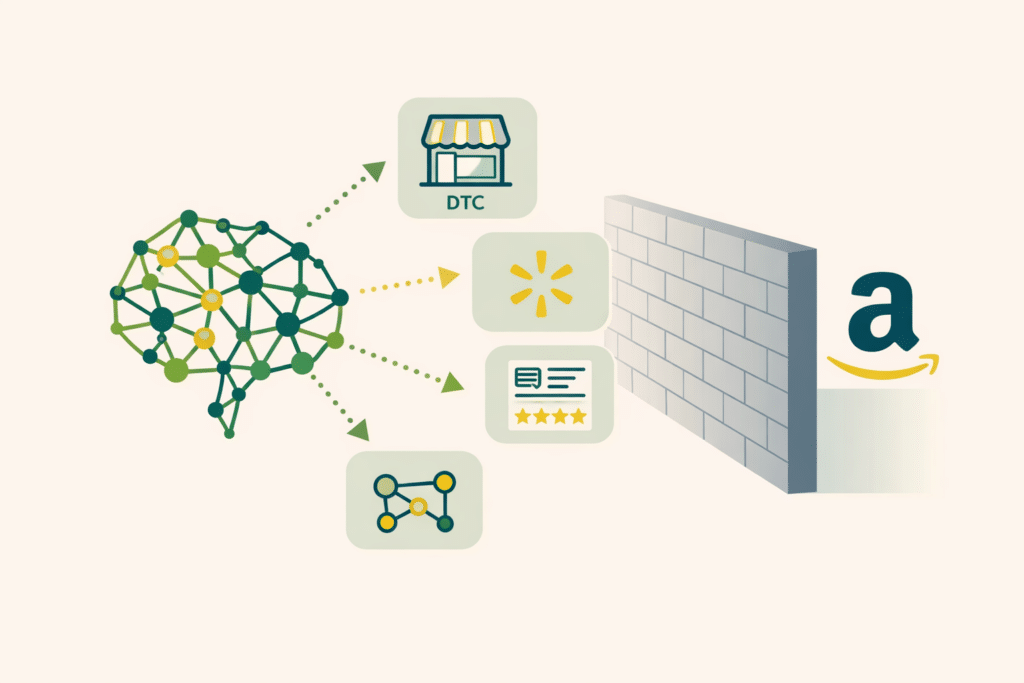
Tools like ChatGPT, Perplexity, and Gemini have a fundamental problem when it comes to Amazon: they largely couldn’t access product data from the platform even before this update. Amazon has used robots.txt, rate limiting, and other technical measures to block AI crawlers from freely scraping product pages. The new BSA formalizes that posture and closes off the authenticated back doors that might have served as data pipelines.
The result is that generative search engines don’t have direct, reliable, current Amazon data at scale.. When someone asks ChatGPT to recommend the best protein powder or compare running shoes, that answer is being built from sources other than Amazon’s actual listings. This matters more than most brands realize.
If your product information lives primarily on Amazon and nowhere else, you’re largely invisible to the AI systems that are increasingly shaping purchase decisions before a consumer ever opens a browser tab.
How to Build Generative Search Presence When Amazon Is Off-Limits
The strategic shift here is one we’ve been advising clients to make anyway: stop treating Amazon as your only source of product truth online.
Your DTC site or brand hub should be the most comprehensive, richly detailed version of every product you sell. That means full spec tables, use cases, comparison content, buying guides, and FAQ sections that answer the questions your customers actually ask. Amazon’s listing constraints won’t let you publish all of that there anyway, so your owned properties are the natural home for it.
Schema markup matters more than it used to. Structured data (product, review, FAQ, how-to) makes your content easier for generative systems to ingest, summarize, and cite. If you haven’t done a schema audit on your DTC site recently, now is a good time to do that.
Multi-channel presence also helps. If your catalog appears across Walmart, Target, and specialty retailers in addition to Amazon, generative systems can form an accurate picture of your products without relying on Amazon at all. The more surface area your brand has on crawlable channels, the more accurately AI systems can represent you.
The broader principle: Amazon will remain your conversion engine, but it should not be the only place where your product information exists on the internet. That dependency was always a risk. This BSA update just makes it more visible.
The Amazon AI Agent Compliance Checklist

Most brands don’t need to panic, but a few actions are worth completing before the deadline. First, audit every third-party tool that accesses your Amazon account and confirm it meets the new Agent requirements. Second, contact your major vendors and ask directly whether they’re compliant with the March 4 BSA update. Third, verify that kill switch capability exists for each tool, either on the vendor side or your own.
If you’re running any internal automation, scripts, or custom integrations, review them with someone who understands the new language in Section 19. The definition of “Agent” is broad enough that standard fulfillment automation likely qualifies.
Canopy Management
Built for Amazon. Designed for Growth
Ready to partner with a team that has the systems and expertise to scale your brand?
Canopy Management delivers end-to-end eCommerce growth, leading the industry in Amazon marketplace strategy while powering expansion through Shopify, Meta, and Google. Our full-funnel approach — from marketplace optimization to customer acquisition — has generated over $3.3 billion in partner revenue and made us the trusted growth engine for brands worldwide.
Schedule a strategy session with our team to discover exactly how our proven frameworks can accelerate your growth.
Frequently Asked Questions
Probably yes. Amazon’s definition of “Agent” is broad and covers automated software accessing Amazon Services. Standard fulfillment automation that calls Amazon APIs to retrieve orders or send tracking information likely falls within scope. The safest approach is to verify with your developer or vendor rather than assume you’re exempt.
Ask three questions: Has your system been updated to identify itself as an automated agent when accessing Amazon? Do you have a process to immediately cease access if Amazon requests it? Are you confident that your data practices comply with the new Section 4.2 restrictions on using Amazon materials for AI development?
Rarely, and not reliably. Most major AI crawlers have been blocked from Amazon product pages for some time. The new BSA update reinforces that direction. For brands that want AI systems to accurately represent their products in generative search answers, the focus needs to shift to owned and third-party channels that AI can actually access.
The new policy gives Amazon authority to restrict access for agents that don’t comply. The risk depends on how aggressively Amazon enforces, which isn’t yet clear. The smarter move is to get compliant before finding out what enforcement looks like.
Ready to Start Growing Your Amazon Brand?
Canopy’s Partners Achieve an Average 84% Profit Increase!
Find out more