Why Your Amazon Health & Beauty Listings Keep Getting Suppressed (And How to Write Claims That Actually Convert)
Most H&B sellers think they have to choose: compliant copy or converting copy. The brands that win have figured out how to write both.


Most listing suppressions in Amazon’s Health & Beauty category aren’t caused by shady products or malicious rule-breaking. They’re caused by copywriting mistakes sellers didn’t know they were making.
The frustrating part? Many of these Amazon sellers were trying to do the right thing. They wrote compelling copy that described real product benefits. They used language their customers actually search for. And then they woke up to a suppressed listing, lost sales, and a vague policy violation notice that didn’t explain what went wrong.
This creates a false choice that traps most H&B sellers: write safe, sterile copy that complies but doesn’t convert, or write compelling copy that sells but risks suppression. Neither option is acceptable when you’re trying to build a real business.
There’s a third path. You can write copy that converts and complies, but it requires understanding how Amazon’s compliance system actually works and building a vocabulary that communicates benefits without triggering automated flags.
Stuck Rewriting Health & Beauty Listings Every Time Amazon Flags Them?
Canopy's Partners Achieve an Average 84% Profit Increase!
Get Your Free H&B Compliance ReviewWhere Health & Beauty Sellers Go Wrong
Most compliance problems in Health & Beauty fall into three categories. Understanding which trap you’re in determines how to fix it.
The Medical Claim Trap
Amazon’s automated systems scan for disease claims, treatment language, and anything that positions a cosmetic or supplement as a drug. Words like “treats,” “heals,” “cures,” “prevents,” and “diagnoses” are highly likely to trigger automated flags and eventual suppression. But the triggers go deeper than obvious medical terminology.
Phrases like “reduces inflammation,” “kills bacteria,” “regulates hormones,” or “repairs damaged cells” are commonly treated as drug-style claims and frequently lead to suppression, even when they’re technically accurate descriptions of how an ingredient works. Amazon’s system doesn’t evaluate scientific accuracy. It looks for language patterns associated with drug claims and flags accordingly.
The trap springs when sellers use language from clinical studies or ingredient research without translating it into compliant consumer copy. Your supplier’s spec sheet might say an ingredient “inhibits melanin production.” Your Amazon listing cannot.
The Bland Copy Trap
Some sellers overcorrect. They strip their listings of anything that could possibly trigger a flag, leaving copy so generic it could describe any product in the category.
“Premium quality skincare product made with natural ingredients for daily use.”
That sentence is completely compliant. It’s also completely useless. It doesn’t differentiate, doesn’t address customer concerns, and doesn’t give anyone a reason to click your listing over the ten others on the search results page.
Bland copy tanks your conversion rate, which tanks your organic ranking, which forces you to spend more on advertising to maintain visibility. The compliance “solution” creates a profitability problem.
The Backend Keyword Trap
Here’s where things get subtle. Some sellers keep their visible listing copy clean but stuff restricted terms into backend search fields, thinking customers won’t see them and Amazon won’t care.
Amazon cares. The same compliance systems that scan your bullets and descriptions also scan your backend keywords. In some cases, restricted backend terms trigger faster suppression than front-end violations because they look like deliberate attempts to circumvent the rules.
We’ve seen listings suppressed for backend keywords the seller forgot they added months earlier. A product launch keyword strategy becomes a compliance liability when Amazon updates its restricted terms list.

How Amazon’s Compliance System Actually Works
Amazon’s listing compliance operates on multiple layers, and understanding each one helps you write copy that passes all of them.
Automated Keyword Scanning
The first layer is pattern matching. Amazon maintains lists of restricted terms and phrases that trigger automatic review or suppression. These lists aren’t public, but they follow predictable logic: FDA-regulated drug claims, disease references, absolute medical outcomes, and certain ingredient claims that cross into drug territory.
The system also flags proximity patterns. “Vitamin C” alone is fine. “Vitamin C treats” followed by almost anything will likely flag. The automated system looks for restricted terms but also for restricted term combinations.
Category-Specific Rules
Health & Beauty has stricter compliance requirements than most Amazon categories because the products intersect with FDA regulations. What’s permissible in Home & Kitchen might get suppressed in Beauty. Choosing an agency for a regulated beauty catalog? Reach out to Canopy Management’s Amazon advertising team. They’re not just experts in Amazon compliance, they’re pros at the kind of niche-specific ad strategy that separates category winners from the rest.
Supplements face the tightest restrictions. Structure/function claims are allowed (“supports immune health”) but disease claims are not (“prevents colds”). The line between them isn’t always obvious, and Amazon’s automated system can occasionally flag structure/function claims that would be technically compliant under FDA rules.
Topical products have their own rules around cosmetic versus drug positioning. A moisturizer that “hydrates skin” is a cosmetic. A moisturizer that “treats eczema” is a drug. The product might be identical. The language determines the regulatory category.
Human Review
Some flagged listings get human review. This is where context matters. A human reviewer might approve a borderline phrase that automated systems flagged, or they might catch something the automated system missed.
Human review is inconsistent. The same listing might pass review one day and fail three months later when a different reviewer applies a stricter interpretation. This inconsistency frustrates sellers, but it also means there’s room for persuasive, benefit-driven copy that a human reviewer recognizes as compliant even if it triggered an automated flag.
Writing for Compliance and Conversion
The goal is copy that communicates real benefits using language that doesn’t trigger flags. This isn’t about tricking the system. It’s about translating what your product actually does into vocabulary that Amazon’s compliance framework accepts.
Focus on Outcomes, Not Mechanisms
Mechanism language triggers flags. Outcome language usually doesn’t.
Non-compliant: “Inhibits tyrosinase enzyme activity to reduce melanin production.”
Compliant: “Helps minimize the appearance of dark spots for a more even-looking complexion.”
Both describe the same product benefit. The first explains how the ingredient works at a cellular level. The second describes what the customer will experience. Amazon flags the first because mechanism language sounds like drug claims. The second passes because it describes a cosmetic outcome.

Replace Absolute Claims with Appearance Language
Absolute claims (“eliminates wrinkles,” “stops acne,” “reverses aging”) trigger flags because they position cosmetics as drugs. Appearance language describes the same benefits without making treatment claims.
Non-compliant: “Eliminates fine lines and wrinkles.”
Compliant: “Visibly reduces the appearance of fine lines.”
Non-compliant: “Anti-aging serum that reverses skin damage.”
Compliant: “Supports youthful-looking skin and a refreshed appearance.”
The word “appearance” does a lot of work in compliant H&B copy. It’s the difference between claiming your product changes skin (drug claim) and claiming it changes how skin looks (cosmetic claim).
Use Structure/Function Language for Supplements
Supplements can make structure/function claims that describe how a nutrient supports normal body function. They cannot make disease claims that describe treating, curing, or preventing illness.
Non-compliant: “Boosts immunity to prevent colds and flu.”
Compliant: “Supports healthy immune system function.”
Non-compliant: “Reduces joint inflammation and treats arthritis pain.”
Compliant: “Supports joint comfort and flexibility.”
Structure/function claims require a disclaimer (“These statements have not been evaluated by the FDA. This product is not intended to diagnose, treat, cure, or prevent any disease.”) Amazon often appends this disclaimer on supplement detail pages, but it remains the brand’s responsibility to ensure required disclosures are present.
Backend Keyword Strategy
Your backend keywords should include relevant search terms that customers use, but scrubbed of any restricted language. This is where you capture search traffic for terms you can’t put in visible copy.
Instead of backend keywords like “acne treatment” or “eczema cream,” use “blemish prone skin” or “dry irritated skin.” Customers search these terms. They don’t trigger compliance flags. Your listing becomes discoverable for relevant searches without risking suppression.
Review your backend keywords quarterly. Terms that were safe six months ago might be on Amazon’s restricted list today. A proactive audit costs less than a suppressed listing during peak season.
Stuck Rewriting Health & Beauty Listings Every Time Amazon Flags Them?
Canopy's Partners Achieve an Average 84% Profit Increase!
Get Your Free H&B Compliance ReviewWhat This Looks Like in Practice
One skincare brand we work with was stuck in a cycle of suppression and revision. Their original listing led with clinical language borrowed from their ingredient supplier’s research documentation. Phrases like “clinically shown to increase collagen synthesis” and “reduces transepidermal water loss by 47%” were technically accurate but quickly flagged.
Their first revision overcorrected. They stripped everything and ended up with generic copy that mentioned “premium ingredients” and “quality skincare” without saying what the product actually did. Conversion rate dropped 23% and stayed down for two months.
After joining forces with Canopy Management, the third version found the middle ground. Instead of collagen synthesis, the copy described “firmer, more supple-feeling skin.” Instead of transepidermal water loss statistics, it promised “long-lasting hydration that keeps skin comfortable all day.” Specific enough to differentiate. Compliant enough to stay live.
Click-through rate recovered within three weeks. More importantly, the listing stayed live through two subsequent Amazon policy updates that suppressed competitors still using clinical mechanism language.
The Real Cost of Getting This Wrong
Suppression during a product launch can kill momentum you never recover. Suppression during Q4 can cost a significant portion of your annual revenue. And the indirect costs compound: wasted ad spend driving traffic to a listing that goes dark, inventory holding costs while you wait for reinstatement, and the ranking you lose while competitors capture your customers.
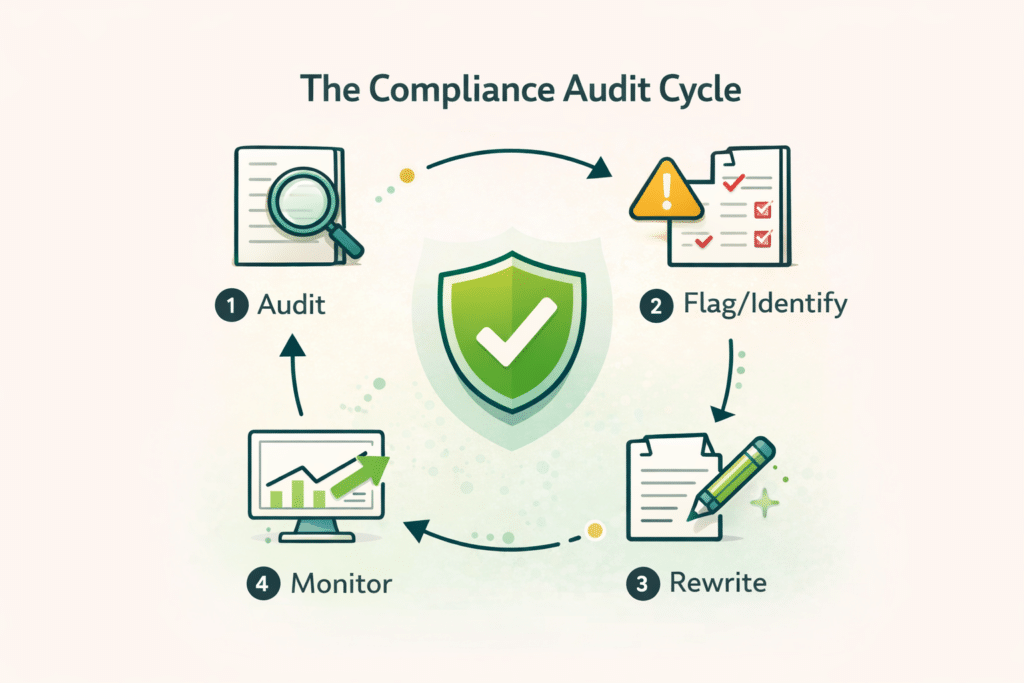
Most sellers treat compliance as a one-time checkbox during listing creation. The brands that stay live treat it as an ongoing discipline, with quarterly audits, proactive language updates, and a vocabulary system that every piece of copy follows.
Frequently Asked Questions
Disease names (acne, eczema, psoriasis, arthritis), treatment verbs (treats, heals, cures, prevents, diagnoses), drug mechanism language (anti-inflammatory, antibacterial, hormone-regulating), and absolute outcome claims (eliminates, removes, stops) commonly trigger suppression. Amazon’s restricted term list isn’t public and changes regularly, so even previously compliant language can become problematic.
Generally no, at least not in their original form. Clinical language like “clinically proven” or specific percentage improvements (“reduces wrinkles by 43%”) often triggers compliance flags because it positions cosmetics as drugs. You can reference that your product contains “clinically studied ingredients” in some cases, but the specific claims from those studies need translation into compliant benefit language.
Structure/function claims describe how a nutrient supports normal body function (“supports immune health,” “promotes joint flexibility”). Disease claims describe treating, preventing, or curing a disease or condition (“prevents colds,” “treats arthritis”). The FDA and Amazon only permit structure/function claims for supplements. The line between them often comes down to whether you’re describing normal function or a disease state.
Reinstatement timelines vary from 24 hours to several weeks depending on the violation severity and your account history. Simple keyword violations often resolve within a few days once you remove the offending language and submit for review. Repeat violations or more serious compliance issues take longer and may require additional documentation.
No. Overly cautious copy that removes all benefit language tanks conversion rates and ultimately hurts your business more than a temporary suppression. The goal is benefit-driven compliance: communicating real product benefits using vocabulary that Amazon’s system accepts. This requires understanding which specific language triggers flags, not avoiding benefit claims entirely.
Stuck Rewriting Health & Beauty Listings Every Time Amazon Flags Them?
Canopy's Partners Achieve an Average 84% Profit Increase!
Get Your Free H&B Compliance ReviewHow Canopy Can Help
Compliance-smart copywriting is one piece of a profitable Amazon strategy. If you’re spending hours rewriting suppressed listings or watching conversion rates suffer from overly cautious copy, our Health & Beauty team can help.
Canopy Management is a full-service omnichannel agency based in Austin, Texas. We run Amazon, Walmart, TikTok Shop, Shopify, Meta, and Google for brands doing $20K to $1.5M in monthly revenue, with the same dedicated brand manager owning the account for the life of the engagement.
The numbers we lead with: $3.3 billion in partner revenue, 84% average year-over-year profit increase, and 99.1% partner retention.
Schedule a strategy session with our team to discover exactly how our proven frameworks can accelerate your growth.