Premium vs. Value Positioning on Amazon: Which Strategy Actually Drives Profit?
When premium positioning works on Amazon, when value wins, and how to calculate which strategy fits your Beauty or Home catalog.


In crowded Amazon categories like Beauty and Home, premium positioning often spikes your ACoS higher than your margins can support.
The same scenario plays out repeatedly: a brand invests in elevated packaging, premium-tier pricing, and sophisticated A+ content, then wonders why their advertising costs are eating their profit. The math looked good on paper. But Amazon’s auction dynamics don’t care about your brand story. They care about conversion velocity and what you’re willing to pay for it.
The instinct to go premium makes sense. Differentiation feels like the smart play in saturated categories. But differentiation only works if your unit economics survive the cost of customer acquisition. For many brands in Beauty and Home, they don’t.
This isn’t an argument against premium positioning. It’s an argument for doing the math first.
What Are Acquisition Costs?
Acquisition costs refer to Customer Acquisition Cost (CAC): how much you spend, on average, to get one new customer.
The standard formula is simple: total marketing and sales spend in a period divided by the number of new customers acquired in that period. In ecommerce broadly, that includes paid ads (Meta, Google, Amazon, TikTok), agency fees, creative production, software, and sometimes a portion of marketing salaries.
On Amazon specifically, acquisition costs show up primarily through your advertising spend. ACoS (Advertising Cost of Sales) measures ad spend as a percentage of ad-attributed revenue. TACoS (Total Advertising Cost of Sales) measures ad spend as a percentage of total revenue, including organic. Both are proxies for how much you’re paying to acquire customers on the platform.
The relationship matters because premium positioning typically means higher CPCs, lower conversion rates (smaller audience willing to pay premium prices), and therefore higher acquisition costs per customer. If your margins can’t absorb those costs, the positioning doesn’t work regardless of how strong your brand story is.

The Premium Trap on Amazon
Premium positioning fails on Amazon when acquisition costs exceed what your margins can absorb, and that happens more often than most brands expect.
Here’s the pattern: a brand prices a product at $34.99 instead of $19.99, expecting the higher margin to offset lower volume. They build beautiful A+ content, invest in Sponsored Brands video, and target category keywords against dozens of established players.
The ACoS lands somewhere between 40% and 50%. At that price point, they need it under 30% to hit margin targets. 2026 benchmarks show Sponsored Brands (premium-heavy) hitting 35-50% ACoS versus Sponsored Products’ 25-35%. The math doesn’t work, and they’re stuck choosing between unprofitable growth or scaling back until the product flatlines.
Premium positioning requires one of the following to be true:
Strong organic ranking that reduces ad dependency. If you’re already ranking on page one for primary keywords, you can afford higher ACoS on incremental ad spend because most volume comes from organic. If you’re not ranking organically, your entire sales volume depends on paid traffic, and premium margins rarely survive that.
High repeat purchase rates that boost lifetime value. Subscribe & Save enrollment or brand loyalty that drives repeat purchases can justify higher upfront acquisition costs. If your LTV is 2-3x your first purchase, you can afford to lose money on initial acquisition. If you’re selling a one-time purchase item, you can’t.
A genuinely differentiated product in a subcategory with lower competition. Premium works in niches where the competitive set is smaller and CPCs are manageable. It struggles in broad, saturated subcategories where you’re bidding against private label, legacy brands, and dozens of me-too products.
Without at least one of these conditions, premium positioning becomes an expensive way to generate low-margin (or negative-margin) sales.

When Premium Positioning Works on Amazon
Premium makes sense in subcategories where the customer is actively looking for quality differentiation and willing to pay for it. In Beauty, this means clinical skincare, professional-grade treatments, and products where efficacy matters more than price. In Home, it shows up in luxury candles, artisan décor, and items where aesthetics drive the purchase.
The common thread: the customer isn’t comparison shopping purely on price. They’re looking for the “best” option in a considered purchase.
In these subcategories, strong A+ content and Amazon Brand Stores drive meaningfully higher conversion rates. Brands achieve 15-25% higher conversions via video and A+ Content in skincare by investing in clinical imagery and detailed ingredient storytelling. That conversion lift changes the ACoS math.
Premium also benefits from Subscribe & Save dynamics in consumable categories. A $45 serum with 35% S&S enrollment has a very different LTV profile than one with 5% enrollment. The repeat revenue compounds, TACoS drops over time, and higher upfront acquisition cost becomes justifiable.
The key question: is your category one where customers will trade up, and do you have the content, reviews, and product quality to earn it?
When Value Positioning Wins
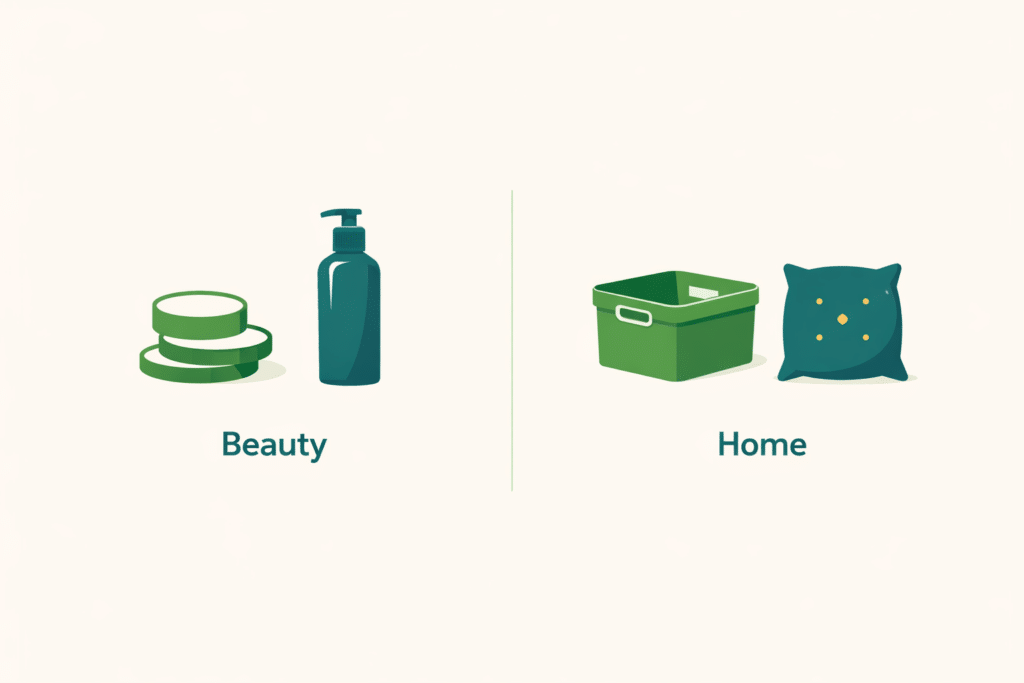
In functional categories where the customer wants a solution rather than an experience, value positioning typically outperforms premium. This includes most Home organization products (bins, shelves, hangers), cleaning tools, and Beauty basics like cotton pads, makeup brushes, and applicators.
In these categories, price is a primary decision factor. Customers compare options, and they’re not paying a 50% premium for marginal quality differences. The path to profit is volume: lower price, higher velocity, tight ACoS management.
Value positioning done well targets 15-30% ACoS with exact match efficiency. CPCs are up roughly $1 on average in 2026, making exact match discipline even more critical for maintaining margins. The margins are slimmer, but velocity makes up for it. A product selling 5,000 units per month at $14.99 with 20% margin and 18% ACoS often outperforms a premium version selling 800 units at $29.99 with 35% margin and 42% ACoS.
This doesn’t mean racing to the bottom. Value positioning still requires differentiation, just not price-based premium differentiation. Bundling, multipacks, and quantity value (e.g., “100-count vs. competitors’ 60-count for the same price”) create perceived value without sacrificing margin.
The strategic question is whether your category rewards quality differentiation or efficiency. If customers treat your product as a functional commodity, forcing premium positioning is expensive and usually unsuccessful.
How to Calculate Which Amazon Strategy Fits
| Positioning | Target ACoS | Margin Goal | Best Fit Categories |
| Premium | 30-45% | 35%+ | Clinical skincare, luxury candles, artisan décor |
| Value | 15-30% | 20-30% | Organizers, storage, cleaning tools, beauty basics |
Before committing to premium or value positioning, run these numbers:
Step 1: Calculate contribution margin at each price tier.
Contribution margin = (Sale price – COGS – FBA fees – variable costs) / Sale price
Run this at both premium and value price points. The difference determines how much room you have for acquisition costs.
Step 2: Estimate realistic ACoS based on category benchmarks.
Premium positioning in competitive categories typically runs 30-45% ACoS. Value positioning with tight targeting runs 15-30% ACoS.
Step 3: Calculate profit per unit at each scenario.
Profit per unit = Contribution margin – (ACoS × Sale price)
If profit per unit is negative or marginal at premium pricing with realistic ACoS, the strategy doesn’t work regardless of branding quality.
Step 4: Factor in repeat purchase rates and project TACoS.
If you have historical data on repeat purchases or S&S enrollment, calculate LTV and adjust acceptable acquisition cost accordingly. TACoS goal for scale: 10-15% (top sellers in Beauty hit 6-10%).
Step 5: Estimate velocity and project total profit at scale.
Model both scenarios at 10x current volume to see which strategy delivers more total profit.
Practical Examples in Beauty and Home
Beauty: Basics vs. Treatments
Cotton pads, makeup remover wipes, and applicator sponges are commodity products. Price sensitivity is high, and the winner is whoever delivers acceptable quality at the best price with Prime shipping. Premium positioning in this space almost never works.
Brands in basics categories succeed by focusing on velocity: competitive pricing, aggressive exact match campaigns with tight ACoS targets, and quantity-based value propositions. With CPCs up roughly $1 on average in 2026, tightening exact match for value SKUs is essential. Monthly volumes of 5,000+ units are achievable.
Treatment serums and clinical skincare operate differently. Customers are researching, reading reviews, and looking for products that actually solve their problem. Strong video content showing results, detailed ingredient breakdowns, and clinical claims (where substantiated) drive conversion at higher price points.
Home: Utility vs. Décor
Storage bins and drawer organizers are utility purchases. Customers want functional, durable, and reasonably priced. Premium positioning in storage bins is a losing proposition. The path to profit is operational efficiency: lower CPCs through exact match discipline, competitive pricing, and bulk offerings.
Throw pillows and decorative objects operate differently. Customers shop aesthetically and will pay more for something that fits their vision. Premium positioning can work, but CPCs are often brutal. Success requires either a strong organic position or willingness to accept higher ACoS during ranking.
Making the Call for Your Amazon Brand Catalog
Most brands have products that suit different positioning strategies. The error is applying a single strategy across the entire catalog.
Audit your Amazon SKUs:
Premium candidates: Products with genuine quality differentiation, in subcategories where customers pay for quality, with strong review profiles and compelling content.
Value candidates: Functional products in commoditized subcategories where price sensitivity is high. Target velocity, keep ACoS tight, focus on exact match discipline.
Unclear: Default to value positioning if uncertain. It’s easier to test premium from a value base than to recover from a failed premium launch.
Frequently Asked Questions
Technically yes, but risky. Price parity issues surface if you’re selling on multiple channels, and customers who find lower prices elsewhere leave negative reviews. Align positioning across channels or be prepared to manage friction.
Look at the top 20 results for primary keywords. If pricing clusters tightly and reviews focus on basic functionality rather than quality differentiation, the category is commoditized. If there’s meaningful price spread and top sellers justify higher prices with differentiated positioning, premium is viable.
Under 35% for Beauty/Home profitability, with 25-30% being ideal for sustainable growth. Work backward from your contribution margin and required profit per unit.
60-90 days with meaningful ad spend. Shorter tests don’t account for seasonality, ranking fluctuations, or campaign optimization cycles.
Positioning strategy isn’t about aspiration. It’s about matching your product to the market dynamics that actually exist. Premium works when the conditions support it. Value works when they don’t. The brands that win know which game they’re playing.
How Canopy Management Can Help
Want to know where your catalog actually stands? Our team can run a Positioning Profitability Matrix audit on your Beauty or Home catalog, benchmark your TACoS against category leaders, and show you exactly where margin is leaking.
Canopy Management delivers end-to-end eCommerce growth, leading the industry in Amazon marketplace strategy while powering expansion through Shopify, Meta, and Google. Our full-funnel approach — from marketplace optimization to customer acquisition — has generated over $3.3 billion in partner revenue and made us the trusted growth engine for brands worldwide.
Thinking About Hiring an Amazon Management Agency?
Canopy’s Partners Achieve an Average 84% Profit Increase!
Let’s talk