Some of Your Customers Only Buy on Deal. Amazon Now Lets You Bid on Just Those Shoppers.
Amazon Marketing Cloud can now tell your deal buyers from your full-price buyers, and the data behind it is free through December 31.

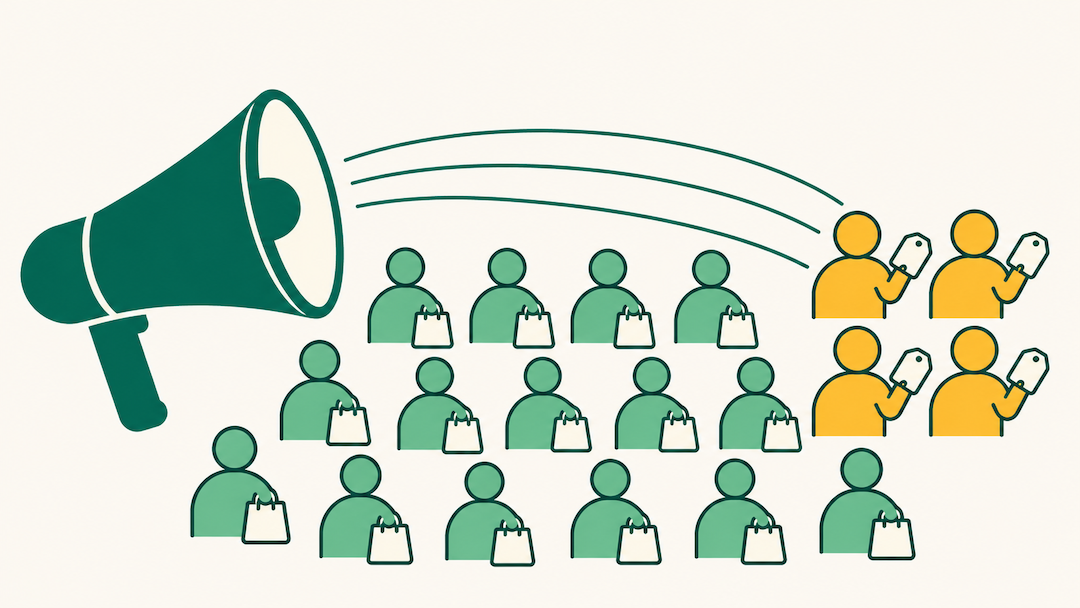
Amazon Marketing Cloud (AMC) now shows which of your customers buy on promotion and which pay full price. In October 2026, Amazon added promotional signals to AMC’s Amazon Retail Purchases dataset, and advertisers can build audiences from that dataset and bid on them. For a brand running deals, that answers a question standard reporting never could: who are you paying to show this deal to?
Two things make this worth acting on before the year ends. AMC is open to every advertiser running sponsored ads, with templates that need no SQL. And Amazon’s own paid datasets, this one included, are free to use through December 31, 2026.
One limit to know up front. An audience changes who sees your ad. It does not change who gets the price. A coupon on your product page is there for every shopper, so this is a tool for spending ad dollars better during a promotion, and it will not hide a discount from anyone.
What Amazon added
The Amazon Retail Purchases dataset holds five years of purchase history for your products. Until this fall it could tell you who bought and when. The update adds how they bought.

According to one vendor’s summary of Amazon’s release note, the addition is 13 columns covering price discount amounts, coupon values, net unit price, promotion type (such as Lightning Deals, coupons and Subscribe & Save) and units purchased on promotion, with two years of history. We have seen the release note’s title in Amazon’s feed and have not read the note itself, so treat the column count as reported.
In plain terms, you can now separate three groups that used to look identical in a sales report:
- Shoppers who only buy from you on a deal
- Shoppers who buy at full price and would have bought anyway
- Shoppers who respond at a shallow discount and never needed the deep one
Who can use it, and what it costs
You no longer need Amazon DSP or a data team to get into AMC. Amazon opened it to all advertisers running Sponsored Products, Sponsored Brands, Sponsored Display or Sponsored TV in September 2025. It sits in the ads console under Measurement & Reporting.
Amazon built it in three layers. No-code templates return visual answers in a few clicks. Low-code templates in the use case library go deeper. The query editor is there for teams that write SQL.
The cost question has a deadline attached. Amazon Retail Purchases is a paid feature, and Amazon’s launch note listed it at $500 a month after a 60-day trial. In June 2026, Amazon announced that its own paid signals would be free for audience creation and measurement through December 31, 2026. If you want two years of promotional history on your own customers without a subscription fee, the window is the next six weeks.
Audiences built from this dataset are available in the United States, Canada, Japan and Australia.

What a sponsored-ads-only brand can do
If you run Sponsored Products and Sponsored Brands without DSP, AMC audiences work as a bid adjustment. You build the audience in AMC, it appears in your sponsored ads account, and you raise your bid when a shopper in that audience searches your keywords. Our post on AMC audience bid adjustments covers the setup.
That makes the play during a promotion simple. Build an audience of shoppers who have bought from you on a deal before, and bid up for them while the deal is live. They have already shown that a discount moves them, and you are no longer paying the same price to reach every searcher.
The reverse matters just as much. When the promotion ends, take the adjustment off. Paying a premium to reach deal-responsive shoppers at full price is the wrong side of the same logic.
At least one practitioner guide reports that these audiences cannot be excluded in Sponsored Products or Sponsored Brands. Amazon’s launch note describes bid adjustment only, so plan on raising bids for the shoppers you want and leaving the rest at your base bid.
What needs DSP
Keeping your full-price loyalists out of deal advertising is the more valuable half of the idea, and it is a DSP job. Amazon DSP lets you choose AMC audiences at the line-item level, which is where a suppression list belongs.

The reasoning is plain. A customer who buys from you every six weeks at full price does not need a display ad announcing 25% off. The ad costs money, and it teaches a reliable customer to wait for the next sale. If you are weighing whether DSP is worth adding, our guide to DSP readiness for mid-market brands walks through the budget math.
AMC also has a code-free high-value audiences tool, launched in beta in 2024, that groups customers by past spend and turns a group into a rule-based or lookalike audience for DSP. Paired with promotional signals, that is how you find the customers worth protecting.
The promotional audience templates
This is the newest piece and the least documented. One industry report this week describes no-code audience templates built on the promotional signals:
- By discount depth. Shoppers who bought at or above a discount level you set.
- By promotional purchase behavior. Shoppers grouped by how much of their buying happens on promotion.
We could not find an Amazon announcement for these templates. Open the use case library in your own AMC instance to confirm they are there before you plan around them. If they are not, the same audiences can be built from the dataset with a query.
The discount depth view is the one we would open first. If most of your promotional buyers converted at 15% off, a 30% deal is giving away margin you did not have to give. That is a pricing decision, and it is worth more than any bid change. Our Black Friday guide makes the same point from the shopper’s side: find the smallest discount that still earns the placement.

How to test one audience
This part is our recommendation. Start with one audience and one clean comparison.
- Pick the audience. Past promotional buyers of your top product line is the obvious first one.
- Give it its own campaign. Run it apart from your other tactics so the results are not blended. If the audience is small, combine related segments until it is large enough to activate.
- Run it through one promotion. Cyber Monday or a December coupon both work.
- Compare, then decide. AMC’s path to conversion and overlap analyses show how the audience performed next to your other campaigns. Look at TACoS for the product, since ad-attributed sales alone will flatter the test.
One measurement note. Standard campaign reporting uses a 14-day window. AMC lets you look back up to 28 days, which gives a fuller picture when shoppers browse for weeks before a deal.
Where Canopy fits
Canopy is a full-service omnichannel marketing agency, and our brand managers run advertising and promotions as one plan for each partner. Canopy partners have generated $3.3 billion in partner revenue, and we hold 99.1% partner retention.
Frequently Asked Questions
No. Since September 2025, any advertiser running sponsored ads campaigns can open AMC from the ads console. Amazon DSP is where AMC audiences can be selected directly for a line item. In Sponsored Products and Sponsored Brands they work as bid adjustments.
No. Amazon provides no-code templates that return visual results, plus low-code templates you can adapt. SQL is only needed for custom queries in the query editor.
Yes. Amazon says advertisers can stream or upload their own first-party signals in pseudonymized form and use them alongside Amazon Ads signals. That lets a brand match a loyalty or email list against ad exposure.
Amazon’s launch note lists the United States, Canada, Japan and Australia for audience creation. Measurement with the same dataset covers those four plus the United Kingdom, France, Germany, Italy and Spain.
Standard Amazon Ads reporting credits the last ad touch within 14 days. AMC lets you set your own attribution rules and extend the lookback to 28 days. It also compares campaigns side by side, so you can see which ones assist a sale and which ones close it.
No. Deals and coupons appear on the product page for every shopper. An audience only controls who your ads reach and how much you bid for them.