Amazon Advertising Automation: Which Tasks to Automate (and Which to Keep Human)
A practical framework for deciding which Amazon PPC tasks belong to machines and which need human judgment. Automate, Supervise, Own.


The pitch sounds great: plug in a tool, let it optimize your bids, and watch performance improve while you focus on strategy.
Then three months later you’re staring at an account where automation aggressively cut bids on your best-performing keywords because short-term ACOS spiked during a stockout. Or you find campaigns burning budget on irrelevant search terms because the “smart” rules harvested anything with a conversion, regardless of whether it made strategic sense.
We’ve audited dozens of accounts where automation was either doing too much or not enough. The pattern is consistent: the highest-performing brands don’t debate whether to use automation. They decide, very deliberately, which tasks belong to machines and which stay on a strategist’s desk.
Automation should do the grunt work. Humans should own the bets.
This framework works whether you manage ads in-house, work with an agency, or use a mix of tools and partners. The point isn’t who clicks the buttons. It’s who owns each type of decision.
Why You Can’t Be 100% Manual or 100% Automated

Amazon advertising has grown past what any human can optimize manually at scale. More ad types, more placements, more targeting options, more data than anyone can process in real time. The person trying to manually adjust bids across thousands of keywords is losing ground to competitors whose systems react faster.
But full automation has its own failure modes. Algorithms optimize for the metrics you give them, not the business outcomes you actually care about. They can’t account for inventory constraints, margin compression, brand positioning, or the fact that you’re intentionally overspending on a launch to build rank.
Automation is genuinely good at speed, consistency, and reacting to micro-changes a human would never catch in time. Humans are still better at strategy, brand judgment, risk tolerance, and understanding how Amazon ads connect to inventory, cash flow, and the rest of the business.
Your goal isn’t to “use automation.” It’s to architect who or what owns each decision in your ad account.
The Framework: Automate, Supervise, Own
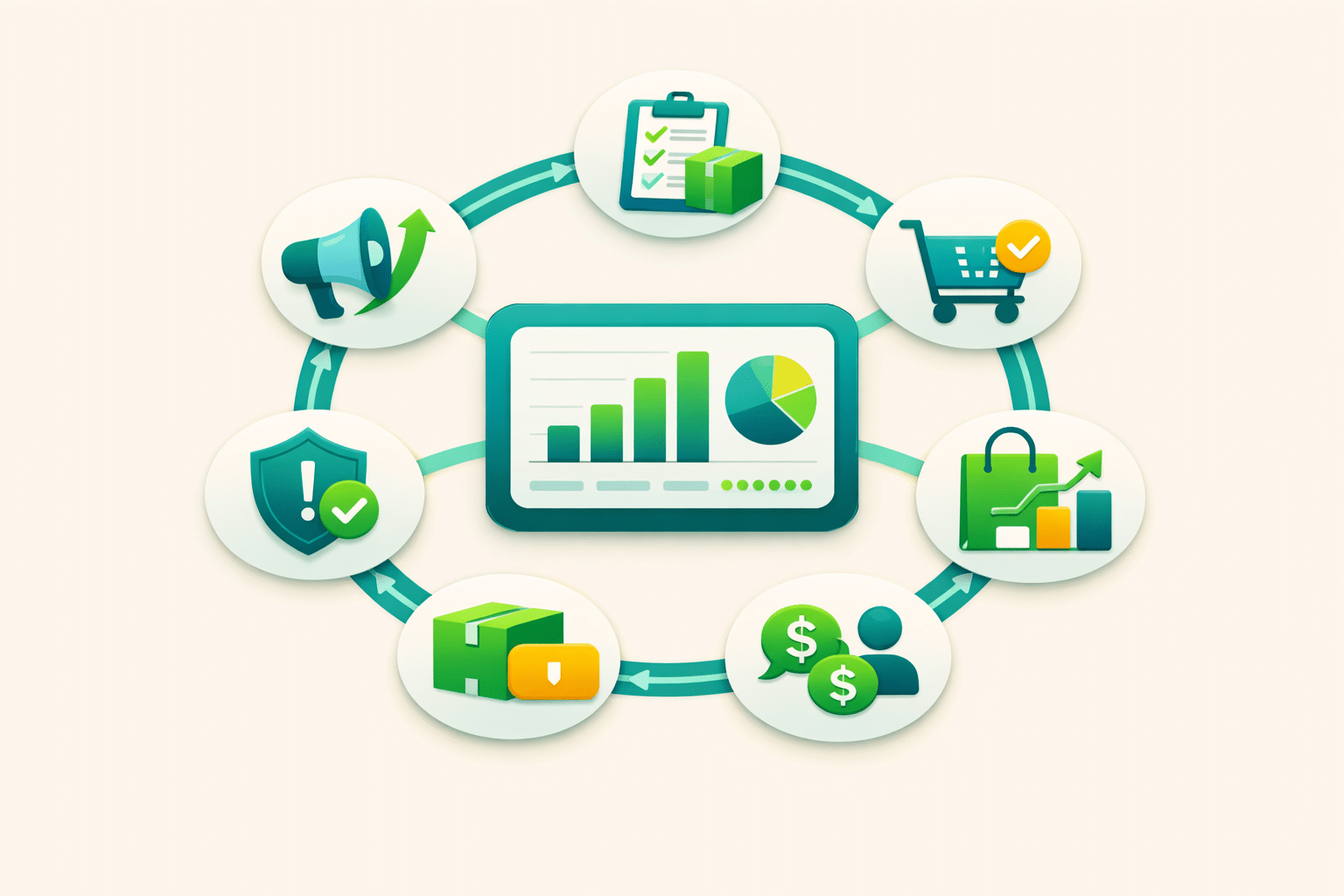
Every recurring task in your Amazon ads workflow belongs in one of three buckets:
Automate: Tasks the machine handles end-to-end with clear rules or models. Minimal human touch. You set the parameters, review results periodically, but you’re not in the weeds daily.
Supervise: Automation executes, but a human regularly reviews outcomes, adjusts guardrails, and steps in for exceptions. The machine does the work; you hold the steering wheel.
Own: Tasks that stay human-led because they’re strategic, creative, or high-risk. These are the decisions where judgment matters more than speed.
The exercise is simple: list every task your team touches weekly or monthly, then force each one into a bucket. Where you place each task determines how you spend your time and where automation adds value versus creates risk.

Tasks You Should Almost Always Automate
These are the tasks every smart team gets off a human’s plate as early as possible. They’re high-frequency, rule-friendly, and don’t require strategic judgment on each individual action.
Bid Adjustments at Scale
You have hundreds or thousands of keywords and ASIN targets. Performance shifts constantly. No human can monitor and adjust bids across all of them with the speed and consistency of a well-configured rule set.
Automation wins here because it can apply logic around the clock without fatigue or inconsistency. A rule like “if ACOS exceeds 35% after 20 clicks, reduce bid by 15%” runs 24/7, but your actual thresholds should match your margins and CPCs, not a generic template. The key is setting intelligent rules with appropriate lookback windows and click thresholds, not just turning on “auto-optimize” and hoping for the best.
Start with Sponsored Products exact match in your mature campaigns where you have clean, stable data, then expand once you’ve validated that your rules behave as expected.
This includes dayparting and seasonal modifiers. Bid changes by time of day, day of week, and seasonal periods (Prime Day, Q4, back-to-school) are tedious to manage manually and straightforward to automate once you’ve identified your performance patterns. Build the rules once, refine each cycle, let the system execute.
Start with your Amazon Sponsored Products exact match campaigns where you have the cleanest data, then expand to phrase and broad once you’ve validated your rule logic.
Budget Pacing and Reallocation
Manual budget management creates a predictable problem: your best campaigns exhaust their budgets by noon while underperformers keep spending. You’re funding losers and starving winners.
Amazon Advertising automation can shift budget toward top performers within guardrails you define, protecting total daily spend while improving allocation. Portfolio-level rules that maintain your overall budget but reallocate based on ROAS or TACOS targets are a practical starting point.
Search Term Harvesting and Negatives
Harvesting means promoting converting search terms from auto or broad campaigns into exact or phrase match, and adding poor performers as negatives. This is high-volume, repetitive work that follows clear logic: X conversions at Y ACOS means promote; Z clicks without a sale means negate.
The workflow practically runs itself once configured. Auto campaigns feed manual campaigns. Conversion-based rules handle promotion. Threshold-based rules handle negatives. You review the outputs weekly to catch edge cases, but the machine does the sorting.
Steady-State Campaign Optimization
Once a campaign is mature, well-structured, and hitting its targets, the ongoing work is incremental tuning rather than strategic rethinking. Small bid adjustments to maintain goals. Minor budget shifts as performance fluctuates.
This is maintenance, not strategy. Automate it so your team can focus on higher-leverage work like launches, creative testing, and account architecture.
Tasks to Supervise: Guardrails on Automated Systems
These are areas where automation executes the work but you stay close enough to catch problems and adjust course. The machine drives; you navigate.
Portfolio-Level Spend and Profit Targets
Automation can optimize ACOS or ROAS at the campaign level while completely missing your actual business goals. Individual campaigns hitting their targets doesn’t mean your portfolio TACOS is healthy or your margins are intact.
The human role is reviewing how automated decisions roll up into P&L reality. When inventory gets tight, you might need to pause automation or tighten rules. When margins compress, your ROAS targets need to shift. The algorithm doesn’t know your cash position or your vendor terms. You do.
Brand Defense and Competitor Targeting
Competitor dynamics shift constantly. Someone starts conquesting your branded terms aggressively. A new entrant undercuts your category. Your own branded campaigns suddenly cost twice as much.
Automation can manage bids and placements on these campaigns, but humans should supervise the strategic questions: When do you escalate defense spending on branded terms? When is competitor targeting worth the premium? These deserve quarterly review at minimum, with the flexibility to intervene when conditions change.
Rule and Model Tuning
Your automation is only as good as its rules. Thresholds, lookback windows, and optimization goals that made sense six months ago may not fit current conditions.
Schedule periodic reviews of your rule logic. Are your ACOS thresholds still aligned with margin reality? Are your click thresholds generating enough statistical confidence? Should you shift optimization from pure ROAS to new-to-brand acquisition for a quarter? The machine can’t ask these questions. You have to.

Tasks That Stay Human-Led
This is the work you should never fully hand to machines. Strategic, creative, or high-stakes decisions where human judgment creates the most value.
Account Architecture and Targeting Strategy
How you structure campaigns, group products, choose match types, and design audience strategies affects everything downstream. Architecture decisions determine data quality, control, and scalability more than any bid rule ever will.
Separate structures for ranking versus profitability. Branded versus non-branded segmentation. Category versus competitor targeting approaches. These are strategic choices that shape how automation performs later. Get architecture wrong and no amount of bid optimization fixes it.
Product Launches and Rank-Building
Launches are intentionally inefficient in the short term. You’re often willing to overspend to build rank, velocity, and review momentum. That’s the strategy.
Automation will try to “fix” bad ACOS by cutting bids, which undermines the entire point of a calculated launch push. Humans need to own launch phases, set phase-specific KPIs (visibility in week one, efficiency by week six), and coordinate the interplay of promotions, coupons, and external traffic. This isn’t optimization. It’s orchestration.
Creative Strategy
Automation can help test headline variations and surface winning combinations. It cannot craft your brand story, decide your positioning, or determine whether you’re leading with problem-solution, lifestyle, social proof, or premium messaging.
Deciding your creative angles, ensuring consistency with your brand voice and off-Amazon channels, and understanding why a headline change from feature-focused to outcome-focused improved CTR: that’s human work. The testing infrastructure can be automated. The strategic thinking behind what you test cannot.
Business-Level Bets
Amazon ads don’t exist in isolation. Inventory levels, DTC performance, retail partnerships, and finance constraints all affect what “good performance” means on any given day.
Deciding when to slow Amazon spend because inventory is tight. Choosing to prioritize share-of-voice over short-term ROAS because you’re defending against a new competitor. Pulling back on an entire category. Entering a new one. Shifting budget toward Sponsored Brand Video and DSP to build awareness for a new hero SKU.
These are bets, not optimizations. The algorithm sees the ad account. Humans see the business. Automation can surface data that informs these decisions, but the risk tolerance, the timing, the trade-offs against other priorities: that’s strategy, and strategy stays human.
How to Audit Your Current Workflow
Run this exercise with your team this week:
Inventory your tasks. List everything you touch weekly or monthly: bid management, search term reports, campaign creation, budget allocation, launch planning, creative development, reporting, competitive monitoring.
Tag each as Automate, Supervise, or Own. Force a choice. If you’re manually doing something that belongs in Automate, you’re wasting time. If you’ve fully automated something that belongs in Supervise or Own, you’re creating risk.
Identify capability gaps. Too much in “Own” and your team is overloaded? You need better tooling, cleaner processes, or outside help. Too much in “Automate” and you’re surprised by results? Tighten supervision and bring more strategic oversight.
Set a 90-day roadmap. Pick two or three tasks to automate next quarter. Pick two or three areas to add more human strategy: launches, creative, portfolio planning. Make the shifts intentional.
If you want a second set of eyes on the results, our team runs this kind of audit regularly across accounts at every stage. We’re happy to walk through it with you.
Canopy Management delivers end-to-end eCommerce growth, leading the industry in Amazon marketplace strategy while powering expansion through Shopify, Meta, and Google. Our full-funnel approach — from marketplace optimization to customer acquisition — has generated over $3.3 billion in partner revenue and made us the trusted growth engine for brands
Ready to Start Growing Your Amazon Brand?
Canopy’s Partners Achieve an Average 84% Profit Increase!
Find out moreFrequently Asked Questions
No universal answer. The right tool depends on catalog size, team capabilities, and customization needs. More important than the tool is defining what you want automated versus supervised versus human-led. A great tool with bad rule configuration underperforms a decent tool with thoughtful setup.
Not well. Launches require intentional inefficiency and phase-based KPI shifts. Automation will optimize for metrics that conflict with launch goals. Keep launches human-led; bring automation back once the product reaches steady state.
Monthly for a quick health check. Quarterly for a deeper review of thresholds, lookback windows, and whether optimization goals still match business reality.
Partially. Bid management and budget pacing can be automated. Strategic decisions about defense spending, competitor response, and how branded spend fits your overall TACOS target need human supervision.
Common signs: unexpected budget exhaustion, performance swings you can’t explain, campaigns optimizing for metrics that don’t match business goals, or surprises in your search term reports. If you’re frequently asking “why did the system do that,” you’ve ceded too much control.
Yes. Auto campaigns remain a key discovery engine. Let them run with clear negatives, then use automation to harvest winners into tightly-structured manual campaigns. Auto doesn’t replace structure; it feeds it.
The framework is the same. What changes is who fills each role. Clarify with your agency: which tasks are they automating, which are they supervising, and which require your input as the brand owner?
The brands that get Amazon advertising right aren’t choosing between automation and manual control. They’re deliberate about which decisions go where.
Automate the grunt work. Supervise where business context matters. Own the strategic bets. Run the audit with your team this quarter, and adjust your tooling and partnerships accordingly.
Thinking About Hiring an Amazon Management Agency?
Canopy’s Partners Achieve an Average 84% Profit Increase!
Let’s talk