Walmart Negative Keywords Are Live: What They Cover and What They Don’t
Walmart Connect turned on negative keywords July 29, 2026. Here’s what the launch covers, the bidding restriction nobody mentions, and how to roll them out.


Walmart Connect turned on negative keywords for Sponsored Products on July 29, 2026. You can now block search terms so your ads stop serving when a shopper’s query matches something you’ve excluded. Two match types, negative exact and negative phrase, applied when you build a campaign or added to ad groups already running. All of it inside the Walmart Connect Ad Center.
Here is the line most of the coverage skipped.
Negative keywords cover manual campaigns and automatic campaigns using fixed bidding. Walmart’s Sponsored Search API documents three bidding strategies: fixed, dynamic, and target ROAS. Only one of them is covered.
If your auto campaign runs anything other than fixed bidding, you do not have negatives available on it until you change the bidding strategy. That one detail decides whether this launch does anything for your account this month or nothing at all.
If you are not on the platform yet, start with getting set up on Walmart Marketplace before tuning campaign structure.
You've Been Paying for Walmart Search Terms You Couldn't Block
Canopy's Partners Achieve an Average 84% Profit Increase!
Talk to a Walmart StrategistWhat Walmart Shipped
Two match types, and they behave the way you would expect if you have run Amazon PPC.
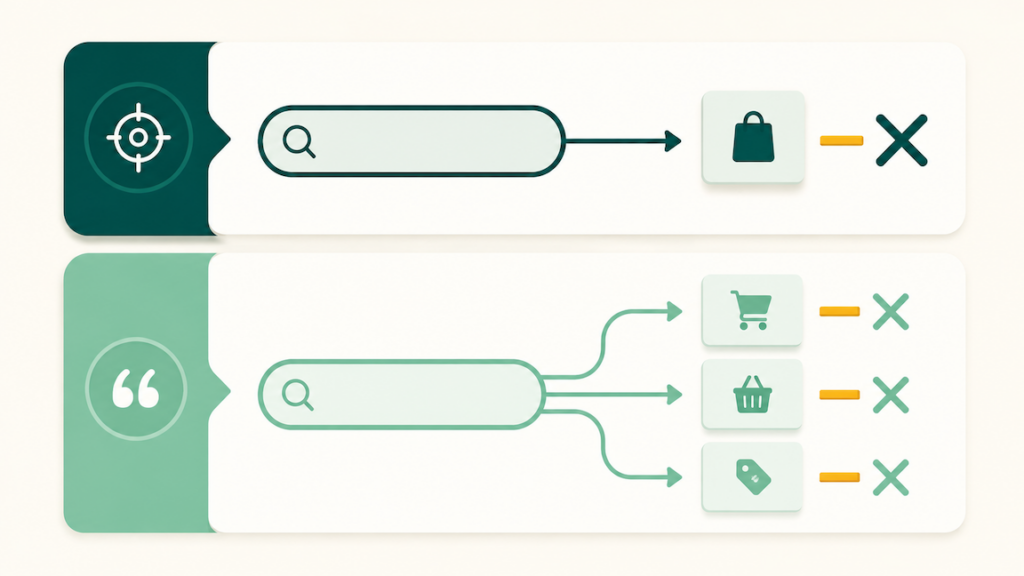
Negative exact-match blocks your ad only when the shopper’s search term matches the excluded keyword exactly. Walmart’s example: “dog food” blocks “dog food.”
Negative phrase-match blocks any search containing the full excluded phrase in the same word order, with other words allowed before or after. Walmart’s example: “running shoes” blocks “white running shoes” and “running shoes for kids.”
Walmart’s launch announcement does not address how close variants are handled, so do not assume one negative covers plurals, misspellings or spacing variants. Watch your own search term report in the first two weeks and add the stragglers as you find them.
The Fixed Bidding Requirement Is the Real Story
Auto campaigns are where the bad traffic lives. That is the point of an auto campaign: Walmart matches you to queries you did not choose, some of which convert and some of which are a laundry brand paying for its own flagship product name inside a campaign built to find new demand.

So the feature most needed in auto campaigns is available in auto campaigns only on fixed bidding. Walmart’s own campaign setup guidance points new advertisers toward automatic targeting paired with dynamic bidding, which is the exact combination the new feature does not cover.
That leaves you a decision rather than a checkbox. Switching an auto campaign to fixed bidding so negatives become available means giving up the real-time bid modulation that was pacing it, and pacing will change. On campaigns with a long, messy search term tail and obvious waste, the trade is usually worth it. On a thin campaign that is barely gathering data, it is not.
Sort your auto campaigns by wasted spend before you touch a single bidding strategy, and convert only the ones where the waste is large enough to pay for the disruption.
Where the Money Has Been Going
In audits of prospective partners’ Amazon accounts, we regularly find 20 to 40% of ad budget going to irrelevant search traffic. Walmart advertisers have had a similar leak with no wrench, and it has a specific shape.
Branded queries inside auto campaigns. Shoppers searching your exact brand name were going to find you. Paying for that click through an auto campaign has been the cost of running auto at all. This is the largest bucket for most brands.
Self-competition across a portfolio. If you run 40 SKUs across three sub-brands, your own items have been bidding against each other on shared category terms. Walmart’s announcement calls this out directly for suppliers managing larger portfolios.
Category-adjacent confusion. The eyeglasses brand serving on “wine glasses” problem. High impressions, real clicks, no chance of a sale.
Wrong-intent modifiers. Searches carrying “cheap,” “refill,” or “replacement” where your item is technically relevant and commercially hopeless.
Pull your Sponsored Products search term report for the last 60 days and sort by spend with orders equal to zero. The first screen of that report is your negative list.
Before You Negate Your Own Brand Name
Here is the wrinkle. Since January 2024, Walmart has offered Brand Term Targeting, which lets advertisers bid on competitor brand keywords through exact match. Your brand name is contestable ground and has been for two years.
That changes the calculus on branded negatives. Stripping your brand terms out of auto campaigns stops you paying for traffic you would have won anyway, which is the right call. Walking away from brand defense entirely is a different decision, and it hands a competitor a cheaper path onto your name.
The workable position is to move branded terms into a dedicated campaign with controlled bids rather than negating them everywhere. You keep a defensive floor, you stop the auto campaign from spending against it, and you can see exactly what brand defense costs you as a line item instead of a smear across your whole account.

Your ROAS Is Going to Drop. That Is the Feature Working.
Most accounts running Walmart auto campaigns since the network launched have been quietly propping up reported returns with branded traffic. Strip that out and the number on the report gets worse while the business gets better.
Decide who you are explaining that to, and explain it before you pull the trigger. If your leadership team or your sales org watches account ROAS as the headline metric, a drop in September that you did not pre-frame reads as a failure to someone who lacks the context. Send the note in advance. Show the branded spend you are removing, name the expected ROAS decline, and point at incremental sales and total ad cost of sale as the numbers that will tell the truth.
Practitioners quoted in trade coverage also expect competition on contested category terms to get more expensive, as brands parked on cheap branded traffic redeploy that budget. Worth planning for, though nobody has data on it yet.
A First 30 Days That Won’t Break Anything
Days 1 to 3. Pull 60 days of search term data across every Sponsored Products campaign. Tag zero-order terms with above-average spend, and tag your own brand terms separately. Do not add anything yet.
Days 4 to 7. Start with negative exact on the obvious waste: specific queries with real spend and no orders. Exact is reversible and low risk. Leave phrase alone for now.
Week 2. Identify auto campaigns where the waste justifies moving to fixed bidding. Convert those, apply the negatives, and note the date so you can read pacing changes correctly later.
Week 3. Escalate to negative phrase only where you have proof of a pattern across multiple terms, not a single ugly query. Phrase negatives block whole themes and they will take profitable long-tail searches with them if you guess.
Week 4 and ongoing. Re-pull the report weekly for the first month, then move to biweekly. Negatives are maintenance, not a project. The list you build in August will be blocking converting terms by next spring if nobody revisits it.
Set your thresholds by spend rather than click count. Walmart CPCs run lower than Amazon’s in most categories, so a click threshold you imported from an Amazon account represents materially less money at risk and will have you negating too early. Decide the dollar figure a term is allowed to spend without an order, and apply that.
Everything above is the same discipline that governs a negative keyword strategy on Amazon, with a shorter data history and one bidding restriction Amazon does not impose. Do not import your Amazon negative list wholesale. Walmart’s shopper mix skews differently on price-modifier queries, and terms that waste money on Amazon sometimes convert here.
What This Launch Does Not Cover
Walmart’s announcement is scoped to Sponsored Products. Sponsored Brands and Sponsored Videos are not named in it. If you run those formats, plan your negatives around Sponsored Products and verify format-level availability in your own Ad Center rather than assuming parity.
Managing exclusions across a large catalog is its own problem, which is one reason the AI tooling inside Walmart Connect matters more this quarter than last. If you would rather hand the whole sequence to someone who runs it across accounts, that is what full service Walmart management covers.
The feature closes a gap that cost Walmart advertisers money for years. It does not manage itself, and the first 30 days is where most of the value is either captured or left on the table.
How Canopy Management Can Help
Canopy Management is a full-service omnichannel agency based in Austin, Texas. We run Amazon, Walmart, TikTok Shop, Shopify, Meta, and Google for brands doing $20K to $1.5M in monthly revenue, with the same dedicated brand manager owning the account for the life of the engagement.
The numbers we lead with: $3.3 billion in partner revenue, 84% average year-over-year profit increase, and 99.1% partner retention.
Schedule a strategy session to see how we’d approach your account.
You've Been Paying for Walmart Search Terms You Couldn't Block
Canopy's Partners Achieve an Average 84% Profit Increase!
Talk to a Walmart StrategistFrequently Asked Questions
Walmart Connect introduced negative keywords for Sponsored Products on July 29, 2026, and describes it as a new capability. Some older third-party guides referenced Walmart negatives before that date, which is part of why the answer feels murky, and Walmart’s Onsite Display keyword targeting has separately operated from target and negative keyword lists. For Sponsored Products in the Ad Center, treat July 29, 2026 as the start date.
Walmart’s announcement covers Sponsored Products. Sponsored Brands and Sponsored Videos are not included in it. Check your own Ad Center before building a plan that assumes coverage across every format, since availability can expand without a separate announcement.
Automatic campaigns support negative keywords only on fixed bidding. Walmart’s advertising API documents three strategies, fixed, dynamic and target ROAS, and the launch covers only the first. If yours runs dynamic or target ROAS, the option will not appear until you change it. Expect pacing to shift after the switch.
Start with exact. It blocks one query, the damage from a bad call is small, and it reverses easily. Move to phrase only after you see the same irrelevant theme across several different search terms, because phrase blocks every query containing that word order and will take profitable long-tail traffic with it.
Not by themselves. Blocking a search term stops spend on that query, but your budget stays where you set it, so the money reallocates to whatever else your campaign can serve on. That’s the point: the same dollars buy better traffic. If you want spend to come down, lower the budget as a separate decision and watch the two changes independently so you can tell which one moved your results.
No. Negative keywords apply to paid placements. Blocking a term stops your ad from serving on that query and leaves your organic listing eligible to appear in those same results.