Walmart Marketplace SEO: How to Rank Products as an Amazon Seller
Here’s what transfers directly to Walmart, and where your existing instincts will quietly suppress performance.


Amazon sellers expanding to Walmart bring real advantages. You already understand keyword relevance, listing quality, and the relationship between conversion rate and organic rank. That foundation transfers.
What doesn’t transfer cleanly is the specific weight Walmart places on factors Amazon sellers typically treat as secondary, and the assumptions baked into Amazon-optimized listings that quietly suppress performance on Walmart. Sellers who treat Walmart like a slower Amazon end up confused when well-optimized listings don’t rank, and when products with fewer reviews outperform products with better content.
This guide is for sellers who know Amazon and want to understand what’s genuinely different about ranking on Walmart. The goal is the specific mechanics that determine whether your listings find their audience or get buried.
What Is Walmart’s Search Algorithm and How Does It Work?
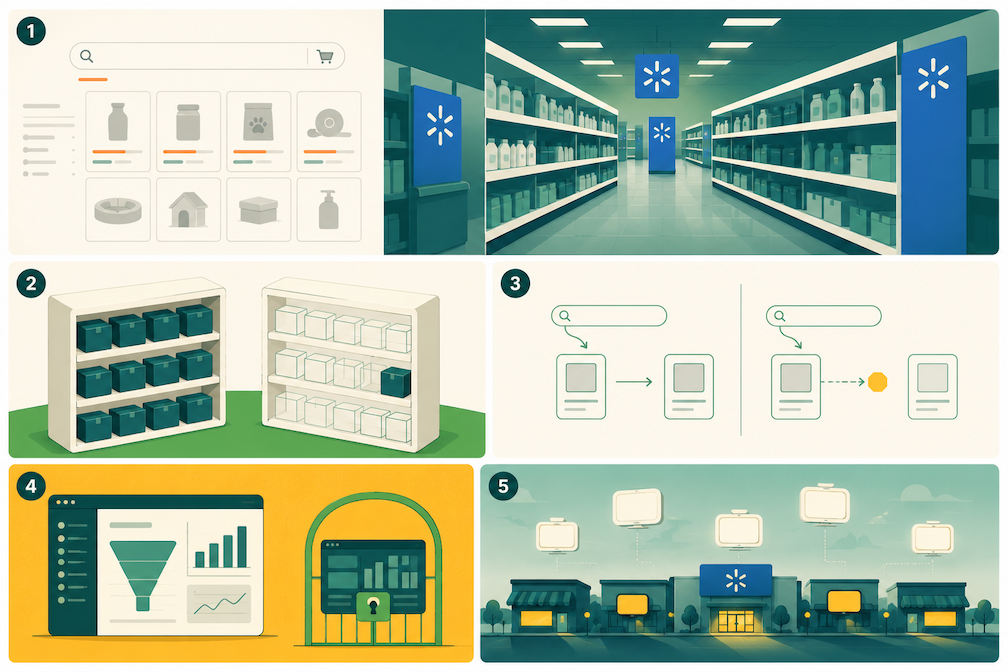
Walmart’s search engine, known as Polaris, evaluates every listing using three factors that Walmart publicly refers to as the Optimization Triangle: Content, Offer, and Performance.

Content covers the quality and completeness of your listing: title, description, attributes, images, and how accurately the listing is categorized. This is the factor most Amazon sellers instinctively focus on first, and it matters on Walmart too. Content alone won’t carry you the way it sometimes can on Amazon.
Offer covers how competitive your listing is on price and fulfillment speed. This is where Walmart diverges most sharply from Amazon. Pricing competitiveness is a direct ranking input on Walmart, not just a conversion factor. A listing priced outside the competitive range for its category can lose organic visibility regardless of how strong the content is. Walmart will depublish listings that fall too far outside competitive pricing norms for the platform.
Performance covers seller health: order defect rate, on-time shipping, customer feedback, and policy compliance. Poor performance metrics suppress listings, and sustained strong performance helps them rise.
All three factors interact. Strong content with weak pricing gets held back by Offer. Strong content and pricing with a poor seller scorecard gets held back by Performance. The sellers who rank consistently well on Walmart are the ones managing all three simultaneously, not just the one that happens to be most familiar.
Your Amazon SEO Skills Transfer to Walmart. The Assumptions Don't
Canopy's Partners Achieve an Average 84% Profit Increase Across Amazon and Walmart
Get Your Free Walmart Listing AuditHow Walmart SEO Differs from Amazon: Where Your Instincts Need Updating
The instincts that serve Amazon sellers well are built around content and keyword precision. On Amazon, a well-optimized listing with strong PPC support can build rank even before meaningful review velocity. On Walmart, that path is harder.
Pricing
Pricing carries more weight. On Amazon, price affects conversion rate, which affects rank indirectly. On Walmart, competitive pricing is a direct input into the algorithm. This means that a pricing decision made for margin reasons can cost you organic visibility in ways that don’t show up as obviously as a drop in conversion rate.
Fulfillment Speed
Fulfillment speed is a harder gate. Amazon’s FBA advantage is meaningful, but products fulfilled by merchants can still rank and convert well with the right content and reviews. On Walmart, the two-day delivery tag has a more pronounced effect on visibility. Sellers using Walmart Fulfillment Services (WFS) receive preferential treatment in rankings and win the Buy Box at higher rates than seller-fulfilled competitors. If you’re serious about organic rank on Walmart, WFS deserves the same priority you give to FBA enrollment on Amazon.
Attribute Completeness
Attribute completeness punishes gaps more directly. Amazon listing gaps hurt conversion but don’t always tank discoverability. On Walmart, incomplete attributes affect where your listing appears in filtered browse results and how the algorithm scores your content quality. A product missing required category attributes may not surface in filtered searches at all. The shopper who narrows by size, color, or material simply won’t see it. The Listing Quality Dashboard in Seller Center shows you your score and flags what’s missing. Check it before spending on ads.
Reviews
Reviews have less compensating power. On Amazon, review count and velocity contribute meaningfully to ranking, and a strong review profile can offset other weaknesses. Walmart’s algorithm places less relative weight on reviews as a ranking signal, which means newer brands can compete more quickly, but also means that a large review count doesn’t compensate for weak pricing or thin attributes the way it might on Amazon.
What Item Spec 5.0 Changed (and Why It Matters for Ranking)

In August 2025, Walmart completed its migration from Item Spec 4.x to Item Spec 5.0, also called OmniSpec 5. This is the most significant structural change to Walmart listing requirements in recent years, and it directly affects how well your products rank.
Item Spec 5.0 replaced broad, generic attributes with a more granular category hierarchy. The update removed 60% of generic attributes and increased attribute granularity by up to 65%, based on Walmart’s own documentation. What this means practically: listings that were built under the old spec and never updated now have attribute gaps under the new schema. Those gaps affect content quality scoring and filter discoverability.
The most important operational implication: if you submitted your Walmart catalog a year or more ago and haven’t revisited it, your listings may be scoring lower on Walmart’s content quality metric than you realize. Running your catalog through the Listing Quality Dashboard will surface which products have compliance gaps under 5.0.
Sellers who migrated fully and filled in the new required attributes under 5.0 now have a clean structural advantage over sellers who haven’t audited their catalogs since the transition.
Building Titles That Work on Walmart
Walmart’s title guidance differs from Amazon’s in one meaningful way: length. Walmart recommends keeping titles between 50 and 75 characters, considerably shorter than the longer titles Amazon sellers often use to pack in keywords. On mobile, which accounts for a substantial share of Walmart’s traffic, longer titles get truncated in ways that hurt click-through.
The recommended formula from Walmart’s own style guides is: Brand + Size/Specifications (if applicable) + Defining Quality + Item Name + Style (if applicable) + Pack Count.
Front-load your most important keyword. Walmart’s algorithm weights the beginning of the title more heavily, and shoppers scanning results on mobile may see only the first few words. A title that buries the product name or primary keyword after brand and feature qualifiers will underperform against one that leads with what the item actually is.
Avoid keyword-stuffed titles that made sense under Amazon’s older indexing behavior. Walmart’s algorithm penalizes spam signals in titles, and the character limit forces discipline anyway.
Backend Attributes: The Ranking Factor Most Sellers Ignore
Amazon sellers know that backend search terms can extend keyword reach beyond what’s in the visible listing. Walmart has a similar mechanism through backend attribute fields, and it’s consistently underutilized.
Backend attributes are invisible to shoppers but read by Walmart’s algorithm for relevance matching. They’re where you add secondary keywords, alternate product names, common misspellings, and long-tail phrases that don’t fit naturally into the title or description. A kitchen knife brand, for example, might use backend attributes to index for “chef knife,” “cook’s knife,” “vegetable knife,” and “Japanese knife” even if only one term appears in the title.
The most common mistake in this area: leaving backend attributes blank, or copying the same terms from the title. These fields extend your relevance surface. Use them.
Pricing, WFS, and the Ranking Inputs Amazon Sellers Underestimate
On Amazon, you can hold your rank with pricing that’s slightly above the category average if your content, reviews, and conversion history are strong enough. On Walmart, the algorithm is less forgiving of pricing that strays outside the competitive range.

A practical habit worth building: check where your price sits relative to the category range in your Listing Quality Dashboard, and monitor it regularly. Walmart uses real-time pricing data, and competitive dynamics in a category can shift your relative position without any action on your part.
On WFS: the ranking advantage is real and measurable. Listings with the two-day delivery badge appear higher in search results and win the Buy Box more consistently than seller-fulfilled alternatives in the same category. For Amazon sellers who are already comfortable with FBA logistics, the operational lift of enrolling in WFS is relatively low. If you’re planning to invest in Walmart advertising, getting WFS in place first makes that spend more efficient. Ads running against listings with the two-day badge convert better.
How to Approach Keyword Research Differently on Walmart
Amazon sellers often start keyword research with their existing Amazon data and assume it transfers. It’s a reasonable starting point, but Walmart shoppers search differently than Amazon shoppers, and Walmart’s index rewards terms that match its own search behavior rather than Amazon’s.
Walmart has its own autocomplete and search suggestion data, and the search bar itself is one of the best free research tools available. Start typing your primary product terms and note what Walmart surfaces. Those suggestions reflect actual search behavior on the platform.
Tools like Helium 10’s Walmart keyword functionality and Walmart’s own Listing Quality insights surface search volume data specific to the Walmart marketplace. Treat your Amazon keyword list as a hypothesis about what might work, and let Walmart’s own data confirm or refute it before committing to your title and attribute strategy.
Working With Canopy on Walmart SEO
Canopy manages Walmart listings and advertising for brands across categories and revenue levels. What we’ve found across accounts is that the most common barrier to Walmart organic performance is Amazon assumptions applied without adjustment. Sellers who audit their Walmart listings against the Optimization Triangle, get WFS in place, and treat Walmart’s keyword landscape as distinct from Amazon’s consistently outperform those who port their Amazon setup over unchanged.
Our partners achieve an average 84% year-over-year profit increase. If your Walmart listings aren’t performing the way your Amazon experience says they should, get a free account audit and we’ll show you exactly where the gaps are.
Your Amazon SEO Skills Transfer to Walmart. The Assumptions Don't
Canopy's Partners Achieve an Average 84% Profit Increase Across Amazon and Walmart
Get Your Free Walmart Listing AuditFrequently Asked Questions
Walmart’s search engine, known as Polaris, ranks products using three factors collectively called the Optimization Triangle: Content (listing quality, title, attributes, images), Offer (pricing competitiveness and fulfillment speed), and Performance (seller health metrics including order defect rate and customer feedback). All three factors interact, and weakness in any one of them can suppress ranking even when the other two are strong.
The core difference is the weight Walmart places on pricing and fulfillment speed as direct ranking inputs. On Amazon, pricing affects conversion which affects rank indirectly. On Walmart, competitive pricing is scored directly by the algorithm. Similarly, Walmart Fulfillment Services (WFS) produces a more pronounced ranking advantage than FBA does relative to merchant-fulfilled listings on Amazon. Reviews carry less compensating power on Walmart, which means new brands can compete faster, but strong review counts don’t offset weak pricing or thin attributes the way they sometimes can on Amazon.
Item Spec 5.0 is Walmart’s updated listing framework, which replaced the previous 4.x spec in August 2025. It introduced more granular category hierarchies and removed 60% of generic attributes in favor of more specific, relevant ones. Listings built under the old spec that haven’t been updated may have attribute gaps that suppress their content quality score and filter discoverability under the new schema. If you submitted your Walmart catalog before late 2025 and haven’t audited it since, check your Listing Quality Dashboard in Seller Center for compliance gaps.
Yes. Listings enrolled in WFS and carrying the two-day delivery badge consistently rank higher than seller-fulfilled listings in equivalent categories. Walmart’s algorithm treats fulfillment speed as a ranking signal, and WFS listings win the Buy Box at higher rates than seller-fulfilled alternatives. For sellers already using Amazon FBA, the operational lift to enroll in WFS is relatively low and the ranking benefit is meaningful.
Treat your Amazon keyword data as a starting hypothesis, not a confirmed strategy. Walmart shoppers search differently, and the terms that drive volume on Amazon don’t always match what performs on Walmart. Use Walmart’s own search bar autocomplete to surface platform-specific search behavior, and validate keyword priorities using Walmart-specific tools before building your title and attribute strategy around Amazon data.