How to Run Walmart Connect Ads: A Tactical Guide for Amazon PPC Sellers
Already running Amazon PPC? Here’s what transfers directly to Walmart Connect, and where your existing instincts will steer you wrong.

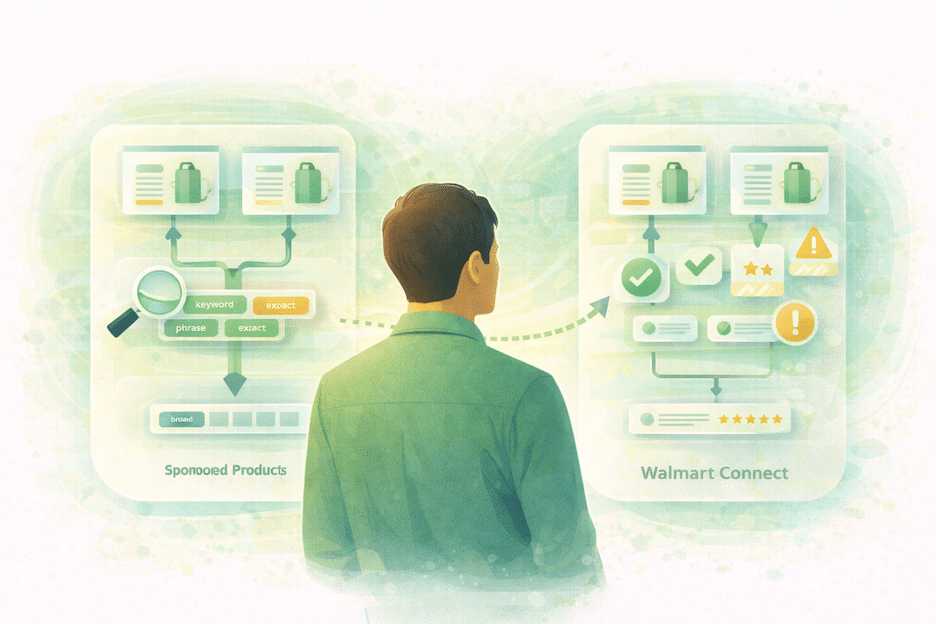
If you already run Sponsored Products campaigns on Amazon, you’re closer to understanding Walmart Connect than you probably think.
- The match types are the same.
- The auto-versus-manual campaign logic is the same.
- The second-price auction mechanic for Sponsored Products is the same.
- The habit of pulling search term reports and harvesting converting queries into manual campaigns are the same.
What isn’t the same is how the platform rewards you for doing it well, and where your existing Amazon instincts will steer you wrong.
This guide is written for sellers who know Amazon PPC and are expanding to Walmart. It skips the basics you already know and focuses on what’s different, what transfers cleanly, and where the platform will surprise you.
Ready to stop leaving Walmart revenue on the table?
Canopy's Partners Achieve an Average 84% Profit Increase!
Find out howThe Ad Format Landscape
Walmart Connect’s core ad formats map fairly cleanly onto what you know from Amazon:
Sponsored Products are keyword-targeted, PPC ads that appear in search results and on product pages. Same concept as Amazon Sponsored Products, same match types, same auto/manual structure. If you’re starting on Walmart, this is where your budget should go first.

Sponsored Brands place your logo, a custom headline, and up to four products at the top of search results. Same function as Amazon Sponsored Brands. The minimum bid is $0.50 (reduced from $1.00 in May 2025 per Walmart Connect)., and brand registration through the Walmart Brand Portal is required.
Sponsored Videos are scroll-stopping video placements in search results. They serve mid-funnel, similar to Amazon Sponsored Brand Videos.
Onsite Display is Walmart Connect’s display advertising format, serving banner placements across Walmart.com and the app. Onsite Display is available to Marketplace brand owners registered with the Walmart Brand Portal. This is also where the mechanics diverge most significantly from Amazon.
Onsite Display uses an eCPM (cost-per-thousand-impressions) first-price auction rather than the second-price model that governs Sponsored Search. You’re not bidding CPC — you’re bidding for impressions, and you pay your winning bid.
Walmart recommends a minimum budget of $4,500 per campaign per month to generate meaningful data from Onsite Display. If your team isn’t ready to commit to that level of investment or dedicated monitoring, stay in Sponsored Search first.
What Transfers Directly from Amazon PPC
The auto-to-manual workflow you use on Amazon works the same way on Walmart. Run automatic campaigns to let Walmart’s algorithm surface converting search terms. Mine the search term report. Move high-performers into manual campaigns where you can control bids by match type.

The three match types – broad, phrase, exact – behave the same way here. Broad for discovery, phrase for balance, exact for precision. If you’ve been running Amazon campaigns long enough to know that broad match on unproven keywords is a fast way to waste money, that instinct applies directly. Start tighter on Walmart than you think you need to, especially while you’re building conversion history.
Negative keywords matter just as much. One thing Amazon PPC managers get wrong when moving to Walmart is assuming they can audit negatives less frequently because Walmart has a smaller search volume base. The opposite is true. Irrelevant traffic burns a higher percentage of a smaller budget. Negative keywords should be reviewed from the first week, not after a month of data.
Where Walmart’s Algorithm Behaves Differently
Here’s what Amazon PPC experience doesn’t prepare you for: on Walmart, your listing quality affects your ad eligibility and placement in ways that are more visible and punishing than what you’re used to on Amazon.

Walmart’s algorithm considers several factors when deciding which sponsored listings to surface – bid amount, keyword relevance, click-through history, and product relevance. But it also factors in your Listing Quality Score, which reflects how completely and accurately your listing is built out. Titles, descriptions, attribute fields, image count, and review volume all feed into this.
On Amazon, a thin listing with strong PPC bids can still win placements. On Walmart, it’s harder. The platform is more reluctant to push ad spend toward listings that shoppers are likely to bounce off of.
If you’re bringing an Amazon-optimized listing to Walmart without adapting it for Walmart’s specific attribute schema and search behavior, your ad performance will be dragged down by listing quality in ways that don’t show up obviously in the campaign metrics.
The practical implication: before scaling Walmart ad spend, audit your listings against Walmart’s attribute requirements. Incomplete attributes for your category directly suppress where your ads can appear.
The Buy Box Requirement You Can’t Ignore
On Amazon, Buy Box eligibility affects how well your ads perform. On Walmart, it’s a harder gate. Products must be Buy Box winners to be eligible for top Sponsored Products placements.
This creates a different calculus than Amazon sellers are used to. Pricing competitiveness on Walmart is a prerequisite for ad placement. If you’re pricing above the Buy Box threshold on key SKUs, you’re not just losing organic sales. You’re losing the ability to bid for the placement entirely.
Walmart Fulfillment Services (WFS) improves Buy Box win rate in a way that closely mirrors the FBA advantage on Amazon. If you’re using FBA on Amazon, setting up WFS for your Walmart catalog is worth prioritizing before you scale ad spend, particularly for categories where fulfillment speed is a meaningful purchase factor.
The Measurement Difference That Changes Everything
This is the part that tends to reshape how Amazon PPC sellers think about Walmart as a channel.
Amazon’s ad measurement is largely self-contained. You’re measuring ad-attributed sales on Amazon.com. The purchase happens where the ad ran. Walmart’s closed-loop measurement tracks purchases across both the online marketplace and in Walmart’s physical stores – more than 4,700 US locations, reaching hundreds of millions of customers weekly across Walmart’s global store network, per Walmart’s fiscal year 2025 annual report data.
That means a shopper who sees your Sponsored Products ad on Walmart.com and later buys your product in a Walmart store can be attributed to your campaign. In categories with strong in-store purchase behavior – consumables, cleaning, personal care, grocery-adjacent products – this changes how you read ROAS.
If you’re evaluating Walmart ad performance only through the online lens you use for Amazon, you may be systematically undervaluing what your campaigns are actually doing. Build in the habit of pulling omnichannel ROAS from the start.
A Practical Starting Framework
For Amazon sellers building their first Walmart Connect campaigns:
Start with Sponsored Products, auto campaigns, on your three to five best-converting Amazon ASINs
Don’t attempt to replicate your full Amazon catalog immediately. Start with proven products that have competitive pricing, strong Listing Quality Scores, and Buy Box eligibility on Walmart.

Run auto campaigns for three to four weeks before launching manual
Walmart’s algorithm needs time to accumulate performance data. Moving to manual targeting too quickly means bidding on assumptions rather than evidence.
Build your negative keyword list aggressively from week one
Pull search term reports weekly. Anything irrelevant gets negated immediately. The accounts we manage that see the fastest improvement in Walmart ACoS are almost always the ones where negative keyword hygiene is treated as a weekly discipline rather than a quarterly cleanup.
Track the omnichannel ROAS, not just the onsite figure
Set this up before you start spending, not after. Retroactive attribution analysis on Walmart is harder than it looks.
Do not mirror your Amazon campaign structure directly
Walmart’s search behavior, conversion patterns, and competitive dynamics are different enough that campaigns built for Amazon rarely perform optimally when imported. Use your Amazon data as a hypothesis about what might work. Let Walmart’s own search term reports confirm or refute it.
The sellers who struggle most on Walmart Connect aren’t the ones who know nothing about PPC. They’re the ones who know Amazon PPC so well that they stop paying attention to where the platforms diverge. The skills transfer. The assumptions need to be checked at the door.
Canopy Management delivers end-to-end eCommerce growth, leading the industry in Amazon marketplace strategy while powering expansion through Shopify, Meta, and Google. Our full-funnel approach – from marketplace optimization to customer acquisition – has generated over $3.3 billion in partner revenue and made us the trusted growth engine for brands worldwide.
Schedule a strategy session with our team to discover exactly how our proven frameworks can accelerate your growth.
Bring your Amazon PPC skills to Walmart without the learning curve!
Canopy's Partners Achieve an Average 84% Profit Increase!
Let's talkFrequently Asked Questions
Brand registry through the Walmart Brand Portal is not required for Sponsored Products. You need it for Sponsored Brands, Onsite Display, and to access Brand Shop. If you’re starting with Sponsored Products only, you can begin without it, but registering your brand early gives you access to more ad formats as your Walmart presence scales.
Your Amazon search term data is a reasonable starting hypothesis for Walmart, but Walmart shoppers search differently. Walmart’s audience skews toward value-oriented and consumable purchases, and category terminology can vary. Run automatic campaigns first to let Walmart surface the actual search terms converting on its platform before committing budget to manual keyword lists built from Amazon data.
Walmart Connect uses closed-loop attribution that covers both online and in-store purchases. A shopper who clicks your ad on Walmart.com and later buys your product in a physical Walmart store can be attributed to your campaign. This is a meaningful distinction from Amazon’s attribution model and is especially important for brands with products that have strong in-store purchase behavior.
Sponsored Search on Walmart generally sees lower competition than Amazon for most categories, which creates opportunities for brands willing to invest early. That said, competition is growing, and the window for establishing low-cost keyword positions is narrowing. The bigger issue for most brands isn’t competition — it’s that Walmart requires well-optimized listings and Buy Box eligibility before ads perform efficiently.
For Sponsored Products, you can start modestly and scale based on performance data. Walmart’s platform requires some spend to accumulate the conversion history that improves your placements over time, so campaigns with very low daily budgets take longer to generate actionable data. Onsite Display has a meaningfully higher minimum investment to run effectively. Most brands new to Walmart are better served starting entirely in Sponsored Search until they’ve established baseline performance metrics.
Bring your Amazon PPC skills to Walmart without the learning curve!
Canopy's Partners Achieve an Average 84% Profit Increase!
Let's talk