Amazon Q3 2026 Earnings: What Sellers Should Plan for in Q4
Amazon expects ad revenue to grow in the high teens this holiday quarter while total sales grow 12% to 16%. Here is what that gap means for sellers, how to keep your margin, and where Canopy can help.

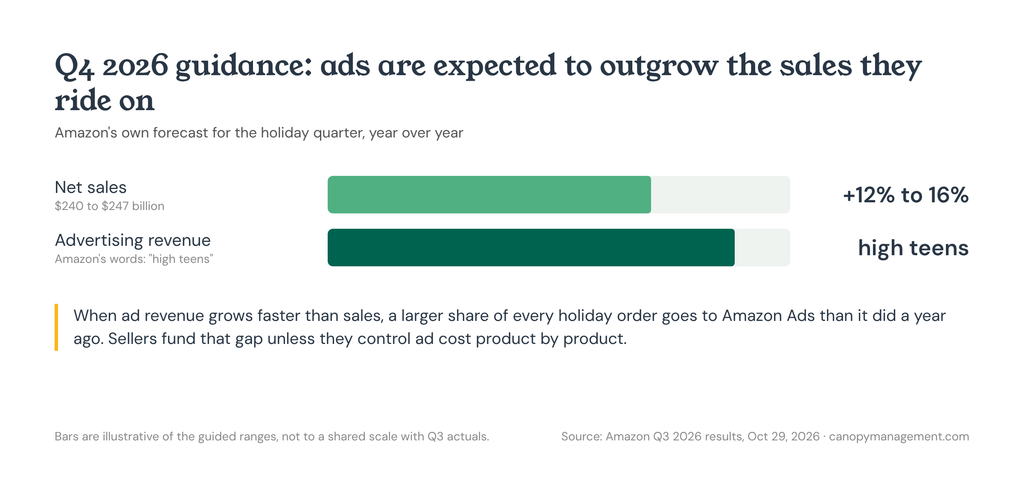
Amazon posted $201.9 billion in Q3 net sales on October 29, up 12%, and told investors to expect advertising revenue to grow “in the high teens” in Q4 while total sales grow 12% to 16%. Read those two numbers together and the holiday quarter is already priced: ad revenue will outgrow the sales it rides on, which means a larger share of every holiday order goes to Amazon Ads than it did last year. If your Q4 plan is “spend more to keep pace,” you are planning to fund that gap yourself.
The quarter also showed how little of Amazon’s retail growth now comes from Amazon selling things. Online stores, the line for products Amazon sells directly, grew 2% to $68.5 billion. Third-party seller services, the referral and fulfillment fees sellers pay, grew 9% to $46.5 billion. Advertising grew 11% as reported (12% excluding currency) to $19.6 billion.
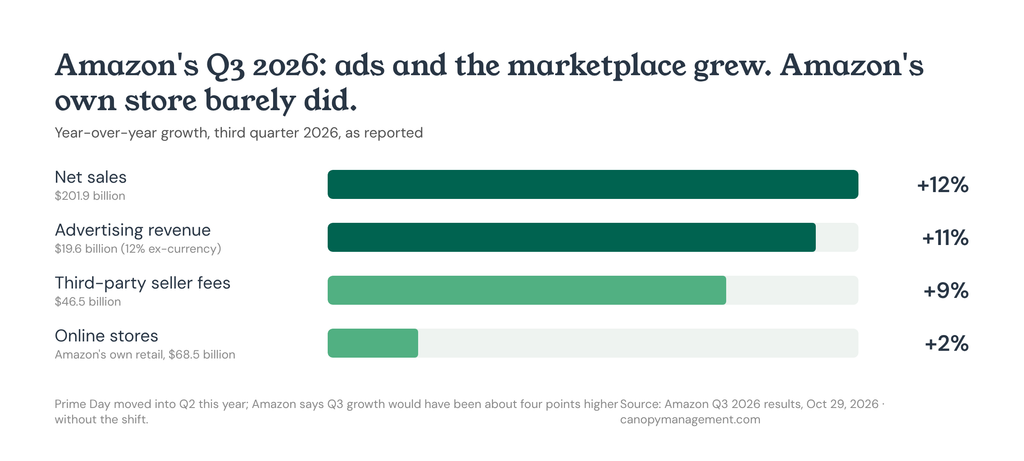
There is a legitimate asterisk. Prime Day moved into Q2 this year for most large countries, and Amazon says Q3 growth would have been about four points higher without the shift. That depresses every retail line in the quarter, not just Amazon’s own. It also means Q4 is the first clean comparison since spring, and Amazon’s own forecast says ads come roaring back.
The landlord quarter
Amazon’s operating margin hit 13.9%, which the company called its highest ever. AWS sales (+39% to $46 billion) did most of that work, at margins the retail business will never see. But look at the retail side on its own terms. Amazon’s first-party store grew 2%. The fees it charges sellers grew 9%. Advertising grew 11%. Seller fees and ads together brought in $66.1 billion in the quarter, nearly as much as Amazon’s own store, and that side of the business is growing four to five times faster.
This is the business Amazon has spent a decade building, and Q3 is a clean picture of it. For sellers, it reframes every “partnership” announcement. The Seller Assistant workflows Amazon highlighted this quarter handle restocking and pricing around the clock. The new Amazon Ads Agent is described as a single AI-first platform for the company’s full ad offering. Both are tools built by the party that profits when you spend. That does not make them bad tools. It means you run them with your own guardrails rather than theirs.
For you, that means paying more each quarter to hold your spot, unless you control ad costs product by product.
What “high teens” is made of
Ad revenue grows three ways: more advertisers bidding, higher prices per click or impression, and more inventory to sell. Amazon doesn’t break out the mix, so nobody outside Seattle knows how much of Q4’s growth will come from your cost per click rising versus Amazon selling more streaming TV slots to national brands.
The product announcements point at the answer. Full-Funnel Campaigns now bundle sponsored ads, display, video, and streaming TV into one campaign for all U.S. advertisers. Ads Agent plans and deploys budget across all of it. Both are designed to move seller and vendor dollars out of Sponsored Products, where the auction is crowded and sellers have spent years learning to be efficient, and into inventory that is harder for a marketplace seller to measure.
Earlier this year Amazon’s releases showed ads growing 24% in Q1 and 26% in Q2 while its online store grew 12% and 15%, ad growth outrunning retail growth by roughly two to one. Q3’s 11% is the Prime Day trough. Q4’s guidance says the pattern resumes.
The practical read for a brand with a fixed holiday budget: assume Sponsored Products CPCs rise, assume Amazon’s tooling nudges you toward upper-funnel placements, and decide before November which nudges you accept. Our Amazon PPC Management guide covers how to set a TACoS ceiling by product rather than by account, which is the control that keeps a hot auction from eating your margin.
The surface nobody is bidding on yet
The number in the release that deserves more attention than the ad guidance: Alexa for Shopping has been used by more than 400 million customers in the last 12 months, and customer interactions with it are up 570% year over year. Amazon shipped more than 100 new capabilities for it this quarter.
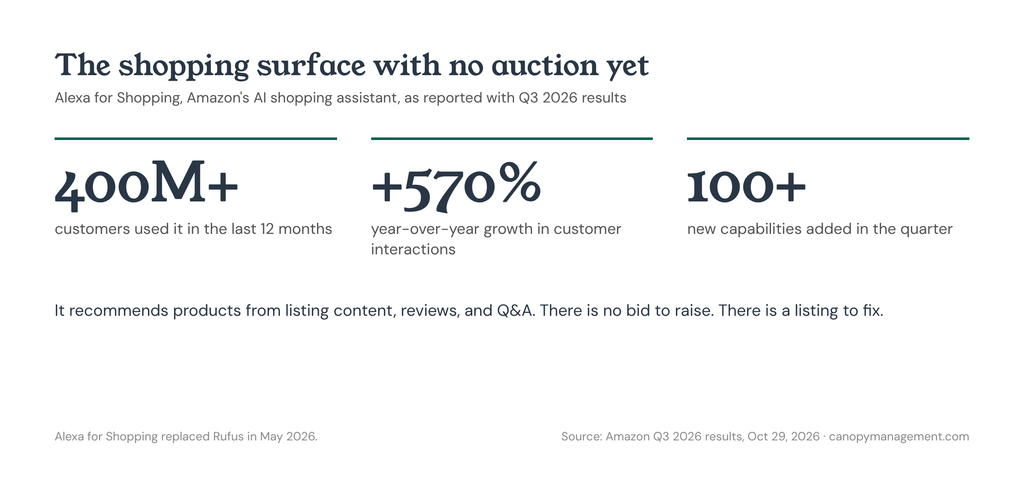
That is a shopping surface growing at a rate no ad auction can match, and the ranking inputs are different. Alexa for Shopping reads your listing content, your reviews, your Q&A, and your A+ copy to decide which products to describe and recommend. There is no bid to raise. There is a listing to fix. Sellers who treat Q4 purely as an advertising problem will miss that the fastest-growing discovery channel on Amazon rewards the one thing you can improve without a budget.
The window is closing, though. Amazon has already begun testing sponsored formats inside Alexa for Shopping conversations, which means the pattern from search results will repeat: content earns placement first, then the auction arrives. The brands that get their listings right for AI shopping in Q4 2026 are the ones that will be cheapest to defend in 2027. The Amazon AI Optimization guide walks through what Alexa for Shopping pulls from a listing and how to structure content so it gets pulled.
When every competitor runs the same pricing agent
One more second-order effect. Seller Assistant now handles pricing around the clock for sellers who turn it on. Automated repricing is not new, but a default, free, Amazon-built agent adopted at scale is. If a meaningful share of your category hands pricing to the same model with the same objective, prices converge faster and the price lever stops differentiating anyone.
That pushes the competitive weight onto things an agent cannot standardize: brand demand that arrives already searching for you, listing content that AI surfaces prefer, review velocity, and distribution outside Amazon that feeds the Amazon flywheel. It is the opposite of how most sellers plan Q4, which is to sharpen the price and raise the bids.
Four moves for your Q4 plan
- Set a per-ASIN TACoS ceiling and hold it. The guidance says the auction gets tighter. Decide now, in writing, what you will pay for a holiday sale on each product, and let the ones that cross the line lose rank rather than lose margin. The products that make it through a crowded December profitably are the ones you double down on in January.
- Fund defense and video before upper funnel. Branded search defense is the cheapest Sponsored Products traffic you will buy all quarter. Sponsored Brands video still converts at rates most display inventory doesn’t. If Ads Agent proposes streaming TV, ask for the incrementality read before you accept.
- Rewrite your top ten listings for AI shopping, not for keyword density. Lead with the specific use case and the comparison a shopper would ask about out loud. Answer the objections in your Q&A. Alexa for Shopping is reading all of it, 400 million customers are asking, and there is still no bid.
- Open a pressure valve off Amazon. Walmart Marketplace is still a less crowded auction, and brands already selling on Amazon can list quickly. Standing it up in November won’t rescue Q4, but it gives you a channel to compare against in January when you are deciding what Amazon’s “high teens” cost you. The Walmart Marketplace guide covers setup and what carries over from Amazon.
If every brand hands pricing to the same agent, price stops setting anyone apart. What still wins is brand demand, listing content AI shopping picks up, review velocity, and selling beyond Amazon. That is the work Canopy’s brand managers do with our partners: per-product profitability targets, ad structures that hold under auction pressure, and listing work aimed at AI shopping surfaces as well as the search results page.

Frequently Asked Questions
Yes, to 11% reported growth (12% excluding currency), from 26% in Q2 and 24% in Q1. The slowdown lines up with Prime Day moving from Q3 into Q2 this year; Amazon put the event’s effect on total Q3 growth at about four points. In dollar terms, Q3 ad revenue of $19.6 billion came in slightly below Q2’s $19.8 billion. Amazon expects growth to return to the high teens in Q4.
Because advertising revenue is paid overwhelmingly by the brands selling on Amazon. When ad revenue grows faster than the sales it supports, the aggregate share of each sale spent on ads rises, which shows up for individual sellers as higher CPCs, more sponsored placements, or both. It has been the pattern in most quarters since 2024.
An AI planning and optimization layer Amazon describes as bringing its full ad offering onto a single platform. It can plan and deploy budget across Sponsored Products, display, video, and streaming TV, and Amazon expanded it to additional countries earlier in 2026. It is useful for execution speed, but its objective is Amazon’s, so set your own profitability guardrails before you let it allocate.
Amazon says more than 400 million customers used it in the last 12 months and that customer interactions are up 570% year over year. It replaced Rufus as Amazon’s shopping assistant in May 2026. It recommends products from listing content, reviews, and Q&A, so listing quality matters more there than bid level.
Not as a blanket rule. The guidance argues for discipline rather than retreat: a per-product cost ceiling, a bias toward branded defense and video over unproven upper-funnel inventory, and a parallel investment in listing content for AI shopping surfaces. Brands that cut spend across the board during a demand peak usually lose rank they then pay more to recover in Q1.