Decoding the Amazon Algorithm in 2026: 10 Things Every Seller Needs to Know
Amazon’s algorithm now runs on AI, and the ranking signals have fundamentally changed. Here’s what actually matters in 2026.


Amazon’s algorithm has changed more in the past two years than in the previous decade. Not cosmetically. The underlying logic of how products get ranked, how search results get generated, and what signals Amazon treats as meaningful has fundamentally shifted.
Understanding those shifts is the difference between gaining organic visibility and wondering why you’re spending more on ads for the same results.
Ultimately, the real question for Amazon sellers in 2026 is . . . .
How Do You Optimize a Product Listing for Better Amazon Rankings?
Optimize for intent, not keyword volume. Write your title, bullets, and A+ content to state what the product is, who it is for, and the problem it solves, then complete every discovery attribute (subject, target audience, intended use) so COSMO can match your listing to situational searches. Conversion rate and sales velocity remain core ranking signals, so keep both healthy.
Here’s how:
| Input | Keyword era | COSMO era (2026) |
|---|---|---|
| Title and bullets | Pack in high-volume keywords | State product, audience, and use case plainly |
| Discovery attributes | Often left blank | Complete subject, audience, intended use |
| What wins relevance | Exact-word matching | Intent match and customer outcomes |
For the field-by-field playbook, from titles and Item Highlights to images and A+ Content, see our guide to optimizing every element of an Amazon listing.
1. The Algorithm Now Understands What People Mean, Not Just What They Type
Amazon’s search system no longer matches keywords the way it used to. COSMO, Amazon’s AI-powered common sense knowledge engine, is now deployed across search relevance, recommendations, and search navigation. It builds connections between what customers search, what they actually want, and which products fit those intentions.
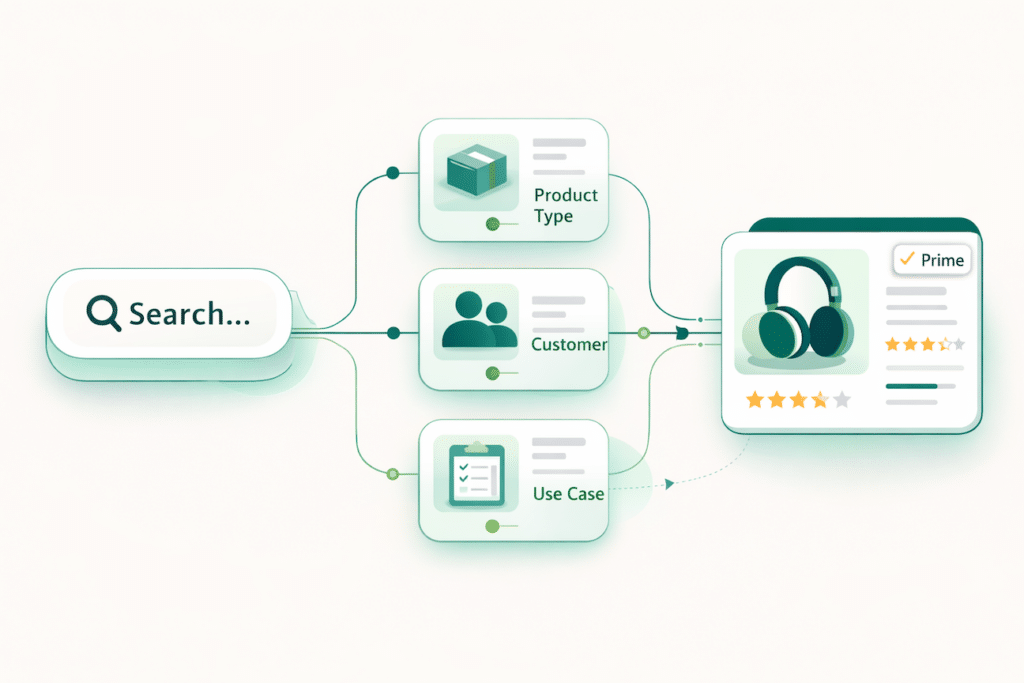
A search for “shoes for a wedding” doesn’t just surface products with those words in the title. The system infers that the buyer probably wants formal dress shoes and returns results accordingly.
For sellers, this changes the optimization equation. Keyword density is less important than whether your listing accurately communicates what your product does, who it’s for, and how customers use it. Discovery attributes in your product template (subject, target audience, intended use) now feed directly into how COSMO categorizes and surfaces your listing.
2. External Traffic That Converts Is a Real Ranking Signal
This isn’t new in 2026, but the weight Amazon places on it has grown. When shoppers find your product through Google, a social media post, or an influencer recommendation and then buy it on Amazon, the algorithm reads that as market validation. Your organic rankings across relevant keywords benefit as a result.
The key word is “converts.” Traffic that bounces tells the algorithm the opposite story. Sending low-quality traffic to your listing to inflate visits is a waste of budget at best and a ranking penalty at worst.
The practical implication: Google SEO and Amazon SEO are no longer separate strategies. Ranking for product-related terms on Google and driving that traffic to Amazon creates a compounding effect most sellers aren’t taking advantage of.
3. Inventory Consistency Affects More Than Your In-Stock Rate
Amazon’s AI evaluates seller reliability over time. A history of stockouts doesn’t just hurt you during the stockout. It damages your algorithmic standing afterward, because the system has flagged your account as an unreliable supply source.
Frequent stockouts now trigger ranking suppression that persists even after you restock. Sellers who treat inventory management as a logistics problem rather than an SEO problem are leaving organic visibility on the table.
Modern predictive tools can model demand using historical sales, advertising spend patterns, seasonality, and market signals simultaneously. If you’re still doing this manually with a spreadsheet, you’re operating at a meaningful disadvantage.
4. Mobile Performance Gets Evaluated Separately
More than half of Amazon’s traffic now comes from mobile devices, and that share has been growing consistently. Amazon evaluates mobile performance as its own signal, which means a listing can be underperforming specifically on mobile without that showing clearly in your aggregate metrics.
Mobile-specific CTR is driven heavily by your primary image. At thumbnail size on a phone screen, most of what makes a listing compelling on desktop disappears. The image has to do more work, faster.
If you haven’t audited your primary images specifically for mobile display, it’s worth doing. Pull up your listings on a phone and look at what buyers actually see.

5. Product Title Guidelines Changed, and Non-Compliance Has Consequences
Amazon began enforcing updated title requirements in January 2025. Titles are limited to 200 characters, special characters are restricted, and repetitive keyword stuffing will get your listing flagged. Amazon may auto-update non-compliant titles after a grace period, and those AI-generated replacements may not represent your product the way you’d choose to.
Getting ahead of this means auditing your catalog now and rewriting titles to be accurate, readable, and aligned with customer intent rather than keyword volume. The good news is that this is also what COSMO rewards.
Ready to Start Growing Your Amazon Brand?
Canopy’s Partners Achieve an Average 84% Profit Increase!
Find out more6. Reviews That Get Marked Helpful Carry More Weight Than Reviews That Just Exist
Amazon’s review system has evolved past raw count metrics. The algorithm now weights review quality, reviewer credibility, and the helpful vote rate on each review. A product with 200 reviews where 80 have been marked helpful will outperform a product with 500 reviews where almost none have.
The implication for review strategy is straightforward: focus on the customer experience that generates detailed, useful reviews rather than on acquisition volume. A buyer who had a problem that was solved well and documents that in a review is more valuable than ten buyers who leave three-word reviews.
Helpful votes are also something you can influence by following up with customers who leave detailed reviews and acknowledging them.
7. Amazon’s Own AI Tools Are Worth Using, With Oversight
Amazon launched its Enhance My Listing tool in May 2025. It uses generative AI to suggest updates to titles, descriptions, attributes, and missing details based on seasonal trends and customer behavior data. Amazon reports that sellers who use it see meaningful improvement in listing quality scores.
The caveat is that AI-generated suggestions need human review before you accept them. The tool has been inconsistent across categories, and sellers who accept suggestions without checking them have ended up with titles or descriptions that don’t reflect their brand accurately. Treat it as a draft generator that surfaces things you may have missed, not a set-it-and-forget-it optimization.
A+ Content is another area where Amazon is rolling out AI-powered improvements. Shoppable A+ Content with interactive carousels and in-content add-to-cart functionality is now available and worth prioritizing for your top-revenue ASINs.
8. Seller Account Health Is a Long-Term Ranking Input
Order Defect Rate still matters, but Amazon’s AI evaluates a broader picture of seller health than it used to. Response times, resolution rates on customer issues, shipping consistency, and Brand Registry status all contribute to an authority score that influences your algorithmic favorability over time.
The practical point is that account health isn’t just about avoiding penalties. Brands with consistently strong metrics earn preferential treatment in how the algorithm handles ambiguous ranking decisions. The gap between sellers who treat account health as a compliance floor and those who treat it as a competitive advantage is wider than most realize.
9. Advertising Performance Quality Matters for Organic Rankings
The relationship between paid and organic performance on Amazon is more intertwined than it used to be. How well your ads convert, the engagement quality of the traffic they drive, and how that traffic behaves on your product page all send signals that the algorithm uses to assess your listing’s relevance.
This means managing PPC purely for ROAS without thinking about what the traffic does downstream is incomplete. A campaign that drives high-volume traffic with weak conversion rates can actually work against your organic standing, not just waste budget.
The accounts we manage where paid and organic strategy are coordinated consistently outperform accounts where they’re treated as separate channels.
The practical version of this, including what Amazon has and has not confirmed about ad-driven sales, is covered in our breakdown of how to blend PPC and organic ranking by product stage.

10. How Alexa for Shopping (Formerly Rufus) Changed Sponsored Ad Discovery
Amazon integrated Sponsored Ads into its AI shopping assistant at the start of 2025, back when the assistant was called Rufus. In May 2026 Amazon renamed it Alexa for Shopping, and the placement carried over.
Your ads can surface through conversational shopping queries, not just traditional search results, and the assistant favors listings that match customer intent expressed in natural language. Products written for how people actually talk about their needs, not just how they type a search, tend to perform better here.
This is still an early placement, and campaign-level reporting for assistant-driven traffic is limited. Even so, it is worth writing your listings in natural, intent-aligned language now, because that foundation will shape how you perform as the placement matures.
For the organic side of the same shift, including what the assistant reads and how to sequence the work, see our guide to optimizing for Alexa for Shopping.
What This Means in Practice
The common thread across all ten of these factors is that Amazon is rewarding sellers who think about the customer experience end-to-end, not just the tactics that used to move rankings.
Ranking factors only pay off when the right terms are in the listing to begin with, which is what our guide to the keyword research process behind those rankings covers step by step.
Natural titles that accurately describe products. Listings that communicate intent and use case, not keyword density. Relevance signals include terms shoppers never see, which is why Amazon backend keywords still influence which queries surface your listing.
Inventory management that builds a reliable history. Ad strategies that drive traffic likely to convert. These aren’t new ideas. They’re just more important now because the algorithm is sophisticated enough to measure them.
The sellers who are gaining ground in 2026 are mostly doing fundamentals well across the board, not finding clever workarounds.
Canopy Management is a full-service omnichannel agency based in Austin, Texas. We run Amazon, Walmart, TikTok Shop, Shopify, Meta, and Google for brands doing $20K to $1.5M in monthly revenue, with the same dedicated brand manager owning the account for the life of the engagement.
The numbers we lead with: $3.3 billion in partner revenue, 84% average year-over-year profit increase, and 99.1% partner retention. Schedule a strategy session to see how we’d approach your account.
Frequently Asked Questions
No. Amazon has never officially released an “A10” algorithm. The underlying system is still A9, though it has been substantially rebuilt around AI and contextual search. COSMO is not a replacement for A9 but an AI layer deployed on top of it.
External traffic that converts well on Amazon. The algorithm treats high-quality converting traffic from Google, social, and other off-platform sources as evidence of market demand, and rewards it with improved organic ranking.
In many cases, yes, though results vary by category. Amazon reports that sellers accept AI-generated suggestions the majority of the time with minimal editing, and listing quality scores improve as a result. The tool is more reliable for established categories than for niche or complex products. Always review suggestions before accepting.
Sponsored Ads now appear inside conversations with Alexa for Shopping, the assistant Amazon launched as Rufus, so your products can show up during natural-language shopping queries. Listings written for real customer intent outperform keyword-stuffed ones in that context.
Not if your listings accurately describe what your products do and who they’re for. COSMO penalizes keyword stuffing and rewards intent-aligned content. Sellers with well-structured listings and complete product attributes are generally benefiting from the shift, not being hurt by it.
Optimize for intent, not keyword volume. Write the title, bullets, and A+ content to state what the product is, who it is for, and the problem it solves, then complete every discovery attribute so COSMO can match your listing to situational searches. Keep conversion rate and sales velocity healthy, since both remain core ranking signals.
No. COSMO filters low-relevance keyword padding and rewards listings that clearly communicate product purpose and fit. Use primary keywords once in the title and backend terms, then spend the rest of the copy on use-case clarity.