How to Become an Amazon PPC Management Expert
Plus: When to Outsource Your PPC Strategy to An Amazon Agency, Best Practices for Getting Started, and How to Know You Found the Right One.

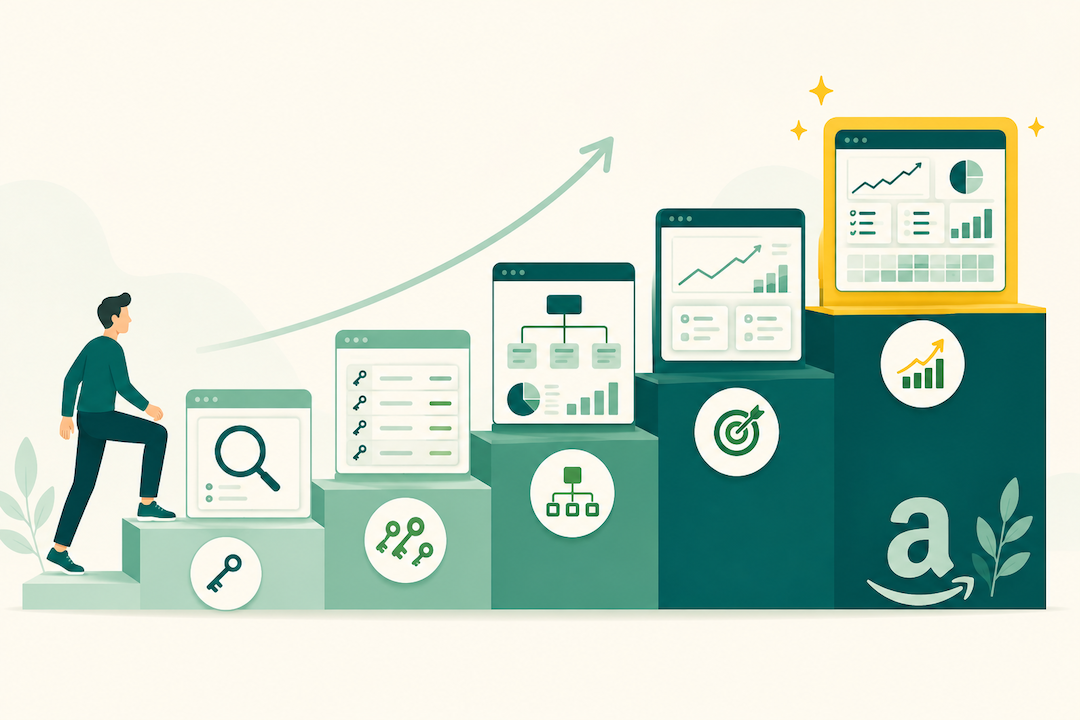
Running successful PPC campaigns takes much more than an advertising budget. It also takes endless hours of keyword research, competitive analysis, ad optimization, split testing, and performance tracking.
This guide helps you get started with your own Amazon PPC campaigns. It also covers the strategies, if and when the time comes, you can use to find the best Amazon agency for the job.
Understanding the Fundamentals of Amazon PPC
The first step to becoming an Amazon PPC management expert is understanding the basics of Amazon advertising.
Amazon is a competitive marketplace with millions of sellers. Amazon’s advertising solutions help marketers and sellers boost visibility, increase sales, and stay ahead of the competition. Like other digital networks, Amazon advertising uses a pay-per-click (PPC) model: you pay when someone clicks your ad.
Before Amazon launched PPC advertising in 2012, an Amazon agency probably relied on search engine optimization (SEO) to boost visibility. Amazon SEO is still central to product ranking, but PPC delivers faster results for brands and marketers.
PPC can look simple, but it goes beyond opening a seller account, logging into Seller Central, and throwing some dollars into the mix. You need a campaign management strategy and a real advertising skill set to run profitable campaigns.
How to Get Started with Amazon PPC
Keywords are the search terms customers use to find products on Amazon. Relevant, profitable keywords boost your ranking and put your ads in front of shoppers searching those terms.
Amazon SEO is critical to long-term success on the platform, and keyword research is an essential piece of the puzzle. In paid advertising, keywords are what connect the shopper to your listing. Understand how customers search, place the right keywords deliberately, and you improve visibility, attract qualified buyers, and grow sales.
Want Experts Running Your Amazon PPC?
Canopy's Partners Achieve an Average 84% Profit Increase!
Get Your Free PPC AuditKeyword Research Strategies
A note on AI keyword tools: Amazon’s AI suggests keywords from your product and competitor data, and those suggestions are useful for surfacing long-tail variations you might miss. But AI tools suggest terms on search volume and relevance alone, without knowing your margins or strategic priorities. Use AI suggestions as research inputs, not your final keyword list. Validate each one against your customer-centric approach and business objectives.
Customer-centric approach. Start your research the way an Amazon PPC consultant would, in the customer’s shoes. Consider the words and phrases they’d use to search for your specific product, and list keywords tied directly to your product’s features, benefits, and intended use.
Long-tail keywords. When you’re starting out, focus on long-tail keywords. They’re more specific and less competitive than broad, generic terms. Instead of “cutting board,” target “handmade wooden cutting board.” Long-tail terms usually signal higher buyer intent and pull in more qualified leads.
Expand your list. To broaden your keyword portfolio, use third-party keyword research tools to see related terms, search volume, and competition levels. Analyze the metrics to find high-potential keywords that fit your product and carry decent volume.
Organizing Your Keywords
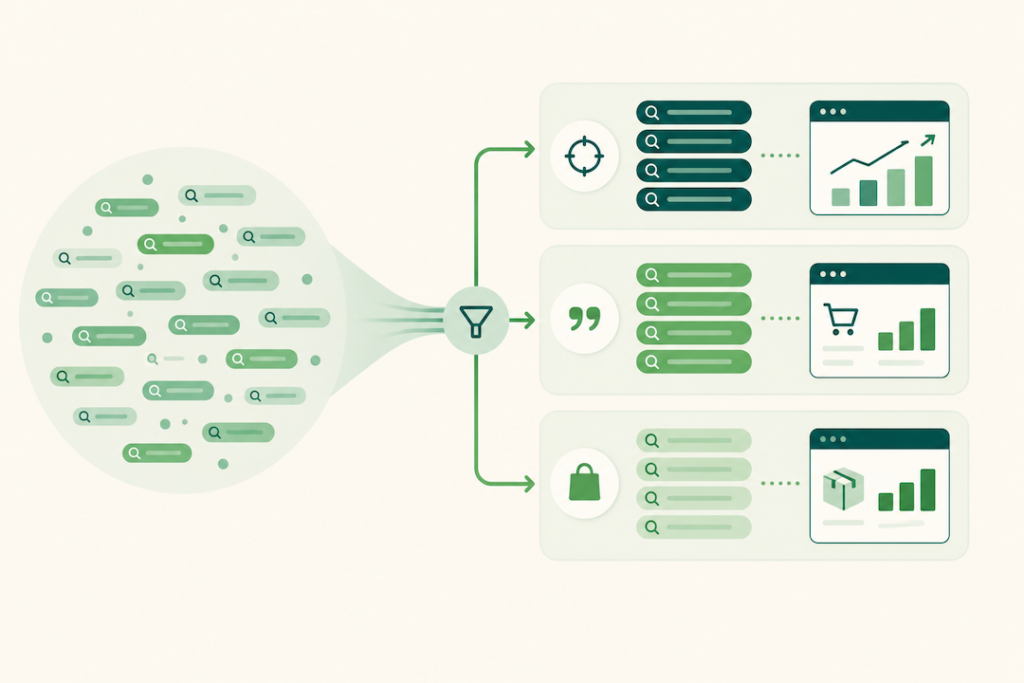
Group by theme. Once you have a full list, organize it. Group keywords into tightly related themes and build separate ad groups or campaigns for each. This keeps relevance high and makes optimization more targeted.
Start with smaller campaigns. When you’re new to this, begin with 10 to 20 keywords per campaign. Smaller campaigns give you better control over daily budgets and make performance easier to track and adjust.
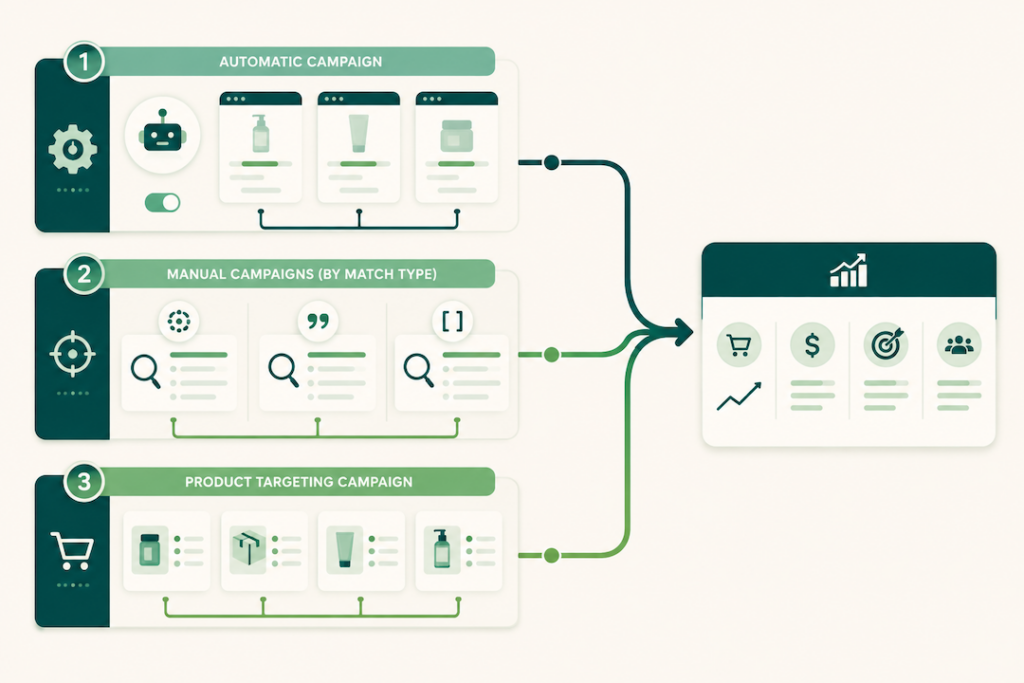
Separate by match type. Amazon offers exact, phrase, and broad match. Create separate campaigns for each so you get granular control and can analyze and optimize based on how each match type behaves.
Bidding and Optimization Techniques
Prioritize high-intent keywords. Not all keywords are equal. Identify the ones with the highest buyer intent and bid higher on them, which sometimes means drilling into a specific product category to sharpen relevance. This lifts ad rank on the keywords that matter, puts your listings in front of ready buyers, and drives conversions.
Set conservative daily budgets. Early on, start with modest budgets, around $10 to $15 per campaign. That lets you gather data and read performance without overspending.
AI-powered bidding. Amazon’s automated bidding uses AI to adjust bids dynamically, and it works best once you’ve built baseline performance data. Run manual bidding for the first three to four weeks to learn your natural conversion patterns and true break-even ACoS. Then test automated strategies with informed guardrails. Remember that AI bidding optimizes for the metrics Amazon prioritizes, which won’t always match your margin and strategic goals.
Analyze and adjust continuously. Optimization never stops. After a few weeks, dig into your search term reports: pause or remove non-performing keywords and move that budget to the ones driving conversions. Once you truly read the underlying metrics, you can build efficient campaigns that stand out.
How AI Is Transforming Amazon PPC Management
Amazon has integrated AI across its advertising platform, but that doesn’t mean you should let it run your campaigns on autopilot.
The platform now offers AI-powered features like automated bidding, dynamic budget allocation, and AI-generated keyword suggestions. These tools analyze more data than any human could, adjusting bids in real time based on conversion probability, time of day, and competitor activity.
Where AI Excels
AI handles the repetitive, data-heavy work well. Automated bidding can make thousands of micro-adjustments daily, catching conversion patterns a human would never spot by hand, using your historical performance, seasonal trends, and live competitive dynamics. Dynamic budget allocation shifts spend toward your best campaigns without constant manual rebalancing, and AI keyword discovery surfaces terms you’d miss in traditional research, especially long-tail and emerging searches.
Where AI Falls Short
AI can’t understand your business strategy. It doesn’t know you’re launching a product and willing to accept higher ACoS temporarily to build organic ranking. It won’t recognize that certain keywords bring higher-lifetime-value customers even when early conversion looks mediocre. Amazon’s AI optimizes for the metric you give it, usually conversions or revenue, but it can’t weigh margin differences between products, category priorities, or positioning goals. It makes mathematically optimal calls on limited inputs, not strategic ones on your full picture.
The Human and AI Approach That Works
The most successful Amazon PPC strategies use AI for execution while humans keep strategic control. Set your campaign structures, match types, and negative-keyword strategy around your business goals, then let AI optimize bids within those guardrails.
Use AI-suggested keywords as a starting point, not a final list, and review them through the lens of relevance, margin, and strategic value. Override automated bidding when you’re launching products, running promotions, or chasing a specific ranking goal. Monitor AI performance weekly and adjust the constraints based on what you see. AI executes your strategy efficiently, but you still need a strategy worth executing.
Questions to Ask an Agency About AI
If you’re evaluating agencies, ask how they balance AI automation with human expertise. Agencies leaning entirely on Amazon’s automated tools or third-party AI platforms without strategic oversight will optimize your campaigns for Amazon’s goals, not yours.
The best agencies use proprietary AI and automation to sharpen human decisions, not replace them. They build custom tools that surface insights and automate the repetitive work, freeing their experts to focus on strategy, creative testing, and business-level optimization.
Is Outsourcing Amazon PPC the Answer?
Amazon advertising drives real visibility and sales, but managing campaigns is complex and time-consuming, especially without deep experience. That’s where a management service earns its keep.
The best agencies staff certified Amazon Advertising specialists who know the platform, the algorithms, and current best practices. As your business grows and your advertising gets more complex, an established service scales your campaigns while holding performance steady and spending efficiently. They track the platform’s changes so your campaigns stay optimized. And for many founders, the biggest win is time: hand off PPC and get back to the rest of the business.
How Do I Choose the Right Amazon PPC Agency?
Start with a proven track record you can verify through case studies, testimonials, and reviews. Confirm the provider staffs certified Amazon Advertising specialists with real, demonstrated expertise.
Transparent reporting and communication matter just as much. A good provider sends regular, clear reports on performance, strategy, and the optimizations they’ve made, and builds a custom strategy for your goals and audience rather than a one-size-fits-all template. Ask which tools and analytics platforms they use and how they make data-driven decisions. Then weigh their pricing and contract terms for transparency and flexibility.
How an Amazon PPC Expert Optimizes Your Campaigns
An experienced expert improves your campaigns on several fronts. Like you would starting out, they run thorough keyword research to find the most relevant, profitable terms so your ads reach the right audience. Unlike most sellers, the best agencies also field data strategists, product managers, and engineers who build custom, high-converting optimization processes.
They read data and market trends to set bid strategies that stay competitive while protecting ROAS. And they monitor and report continuously, giving you clear insight into strengths, weaknesses, and opportunities, then refine listing copy, targeting, and bids through ongoing testing to improve results over time.
How Canopy Management Can Help
Ready to partner with a team that has the systems and expertise to scale your brand?
Canopy Management is a full-service omnichannel marketing agency running Amazon, Walmart, TikTok Shop, Shopify, Meta, and Google for brands doing $20K to $1.5M in monthly revenue, with the same dedicated brand manager owning the account for the life of the engagement. Our full-funnel approach has generated over $3.3 billion in partner revenue, at an average 84% year-over-year profit increase and 99.1% partner retention.
Schedule a strategy session to see how we’d approach your account.
Want Experts Running Your Amazon PPC?
Canopy's Partners Achieve an Average 84% Profit Increase!
Get Your Free PPC AuditWant Experts Running Your Amazon PPC?
Canopy’s Partners Achieve an Average 84% Profit Increase!
Frequently Asked Questions
Most campaigns show meaningful results within 45 to 60 days of structured optimization: data collection in weeks one to three, targeting refinement in weeks four to six, scaling from week eight. Accounts starting above 40% ACoS often improve 8 to 15 points in that window. New product launches take longer, usually 90 to 120 days to build the sales velocity that affects organic ranking.
There’s no universal number; it depends on your margins. Your break-even ACoS equals your unit margin, so 35% margins means 35% ACoS is break-even. For profitability, target 5 to 10 points below that. Some brands run at break-even on new products to build ranking, but that’s a deliberate call made with full margin awareness.
AI tools execute well but can’t build strategy or weigh goals beyond the metrics you feed them. Under $5,000 a month with in-house strategy expertise, AI tools can run your plan efficiently. Above $10,000 a month, agencies usually win by pairing AI efficiency with human strategy. The real question is whether you have the bandwidth to direct those tools well while running everything else.
Most brands allocate 10 to 30% of revenue, depending on category competition, margins, and growth stage. Launches often need the higher end (20 to 30%) to build velocity; established products with strong organic sales hold visibility at 10 to 15%. Budget at least $1,000 to $1,500 a month for meaningful testing, since smaller daily budgets produce unreliable data.
Sponsored Products promote individual listings in search and on product pages; they’re keyword-targeted and usually deliver the best direct ROI. Aamzon Sponsored Brands feature your logo and several products at the top of search, require Brand Registry, and build awareness. Sponsored Display uses audience and behavior targeting and works well for retargeting. Start with Products, add Brands once profitable, then test Display.
Negative keywords stop your ads from showing on irrelevant searches that waste budget, like “free dog toys” when you sell premium ones. Check your search term report weekly and add any query with multiple clicks and zero sales. New campaigns usually need 15 to 30 negatives in the first month; mature ones add 5 to 10 a week. If you’re adding 50+ weekly, your match-type strategy is too broad, so fix that instead of endlessly blocking searches.